


Most B2B companies are playing an SEO game that was retired three years ago. They optimise for traffic. They celebrate impressions. They build content calendars that produce articles nobody with a budget ever reads. And then they wonder why organic sits in the "nice to have" column when the CFO asks where pipeline is coming from.
This guide is not that. It is a framework built from operating B2B SEO end-to-end for SaaS companies, AI-first products, and service businesses that needed pipeline, not pageviews.
The Problem with Conventional B2B SEO
The standard B2B SEO playbook is built around a flawed assumption: that more traffic means more pipeline. It does not. In B2B, buying committees are small, decision cycles are long, and the difference between a visitor who converts and one who bounces is almost entirely about intent and whether your content was built to serve that intent or just rank for it.
We have audited content strategies at companies where the top-ranking pages were bringing in thousands of monthly visitors and generating zero qualified leads. The traffic was real. The business impact was not.
The root cause is almost always the same: SEO was treated as a channel with its own KPIs instead of as infrastructure for a pipeline.
- Keywords were chosen because they had volume.
- Content was written because a competitor had a post on the topic.
- Backlinks were chased because domain authority felt like a measure of something.
- None of it was connected to how buyers actually make decisions.
"Across our portfolio of 20+ B2B products, the companies that made SEO a pipeline driver, not a traffic driver, consistently outperformed. Not slightly. By an order of magnitude."
- Mathi Ganesh, Founder & CMO, GTMVerse
The GTMVerse Pipeline-First SEO Model
Before the seven steps, here is the principle that anchors all of them: every SEO decision must be evaluated against one question. Does this help the right buyer find us at the right moment in their decision?
That question eliminates a lot of noise.
- It eliminates high-volume informational keywords that attract researchers, not buyers.
- It eliminates content produced for content's sake.
- It eliminates link-building that improves metrics without improving trust with your actual audience.
What remains is a tight, accountable system. This is what we call the GTMVerse Pipeline-First SEO Model.
Step 1: Map Keywords to Buyer Stages, Not Search Volume
The most consequential change you can make to your B2B SEO strategy is to stop leading with search volume and start leading with buyer stage. Volume tells you how many people are searching. Buyer stage tells you what those people are trying to do.
In B2B, the searches that generate pipeline cluster into three moments:
- Problem-aware: "why is our sales cycle so long" / "how to reduce customer acquisition cost"
- Solution-aware: "B2B SEO agency" / "content marketing for SaaS"
- Vendor-evaluating: "GTMVerse vs [agency]" / "B2B SEO strategy examples"
Most B2B content strategies over-invest in problem-aware content because the volume is higher, and under-invest in solution-aware and vendor-evaluating content where intent to buy is clearest. The result is an audience of researchers, not buyers.
How to Apply This
- Pull your current keyword targets and categorise each by buyer stage.
- Identify what percentage of your content targets solution-aware and vendor-evaluating queries.
- If that number is below 40%, you have a pipeline problem embedded in your keyword strategy.
- Prioritise closing that gap before adding more problem-aware content.

Step 2: Build Topic Clusters Around Business Problems
Individual blog posts do not generate sustained organic pipeline. Topic clusters do. A topic cluster is a set of content pieces a pillar page and supporting articles all built around a single business problem your buyer is trying to solve.
The pillar page is the definitive, long-form resource on that problem. The cluster content addresses adjacent questions, variations in intent, and related searches. Together, they signal to search engines that you have the deepest, most comprehensive coverage of that problem which is what earns authority.
More importantly, they serve a buyer who is in research mode. A buyer reading your cluster is spending time with your thinking. That time builds trust before they ever talk to your sales team.
What a Cluster Looks Like in Practice
For a client in the revenue operations space, we built a cluster around "B2B pipeline generation." The pillar covered the complete system. Supporting articles addressed pipeline velocity, CRM hygiene for pipeline accuracy, and how to diagnose pipeline leaks by stage. Within four months, organic traffic to that cluster generated 60+ qualified leads per month.
The rule we follow: one cluster per business problem your product solves. If you have five core use cases, you need five mature clusters before you consider expanding. Depth before breadth. This is consistent with our SEO services we build systems, not content libraries.
Step 3: Optimise for AEO and GEO, Not Just Google
The search landscape changed more between 2024 and 2026 than in the five years before it. AI-generated answers now appear at the top of a significant percentage of B2B search queries. Buyers are using ChatGPT, Perplexity, and Google's AI Overviews to research vendors before they ever visit a website.
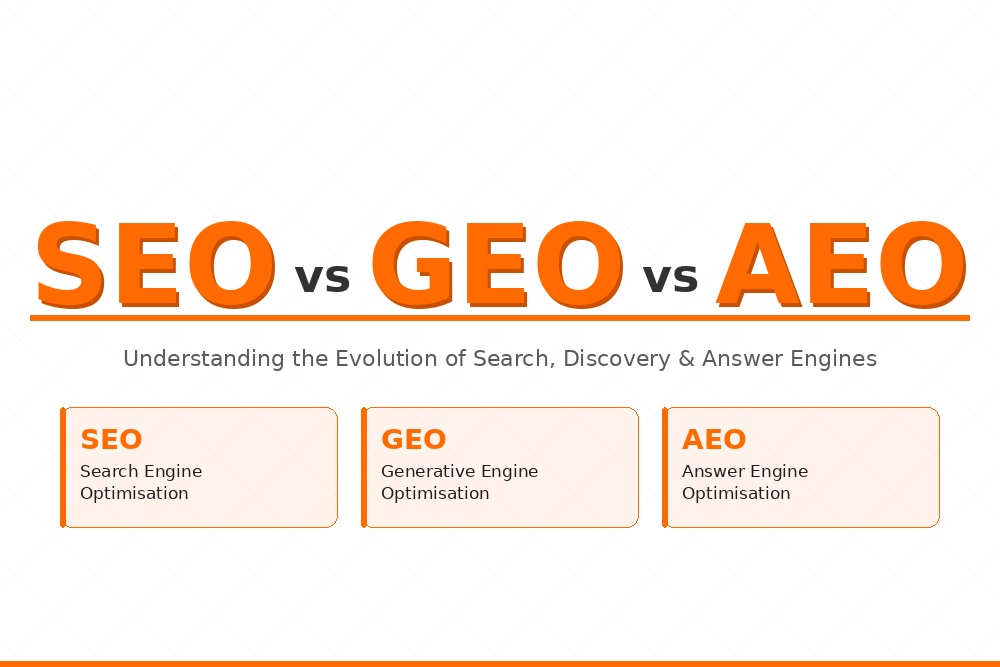
This means your B2B SEO strategy has to account for Answer Engine Optimisation (AEO) and Generative Engine Optimisation (GEO) alongside traditional SEO.
AEO: Being the Direct Answer
AEO is the discipline of structuring your content so it is chosen as the direct answer in AI-generated summaries. The format is specific: lead with a direct definitional answer, then expand with context. FAQ sections with precise, self-contained answers are not optional they are the mechanism by which AI engines identify and surface your content as authoritative.
Every post we publish answers the primary keyword question within the first 300 words, in the exact format search and AI engines look for: "[Topic] is [definition]. Specifically, [expansion]."
GEO: Being in the AI Training Layer
GEO is about proprietary data and first-party insight. AI engines preferentially cite content that contains original frameworks, named methodologies, and data that cannot be found anywhere else. Generic content no matter how well optimised gets replaced by AI summaries. Original insight does not, because AI engines cannot generate what does not exist in their training data.
This is why every major section of every GTMVerse content piece includes at least one first-party data point or client result. Original frameworks like the GTMVerse Pipeline-First SEO Model are not just brand assets they are GEO infrastructure. Our content marketing approach is built on this principle.
Step 4: Fix Technical SEO Before Scaling Content
There is a specific order of operations in B2B SEO that most companies get wrong. They publish content before the technical foundation can support it. The result is content that ranks inconsistently, loads slowly, creates crawl inefficiencies, and loses authority to duplicate or near-duplicate pages.
Technical SEO is not exciting. It does not produce the kind of visible progress that content does. But it is the infrastructure everything else runs on, and broken infrastructure caps your ceiling regardless of how good your content is.
The Technical Audit Checklist We Run Before Content Scale
- Core Web Vitals: LCP under 2.5s, CLS under 0.1, FID under 100ms on mobile
- Crawl budget: No orphan pages, no redirect chains, XML sitemap accurate and submitted
- Canonical tags: Correct on all paginated, filtered, and duplicate-prone pages
- Internal linking: Every cluster piece links to the pillar; pillar links to conversion points
- Structured data: Article schema on all blog posts, FAQPage schema on all FAQ sections
- Index coverage: No unintentional noindex tags, no soft 404s appearing as indexed
Step 5: Build Authority Through Strategic Link Acquisition
Backlinks remain a core ranking signal in 2026, but the bar for what counts has risen. A link from a mid-authority content aggregator does almost nothing. A link from an industry publication your buyers actually read, a partner ecosystem page, or a data-driven study that gets cited carries compounding value.
B2B link acquisition is not a volume game. It is a relevance and authority game. The question to ask about every link opportunity: would my buyer's trust in us increase if they saw this citation?
The Three Approaches That Work in B2B
- Original data and research: First-party data gets cited. If you have client results, benchmark data, or proprietary methodology insights, publish them. We have seen single data-driven posts generate more referring domains in 90 days than broad content programs did in a year.
- Strategic partnerships: Integration partners, complementary tools, and industry associations often have high-authority domains and clear incentives to link to relevant content. This is systematically underused in B2B.
- Earned PR from positioning: When your POV is specific enough and your data is original enough, journalists and newsletter writers reach out. This starts with content quality, not PR outreach.
Step 6: Convert Organic Traffic Into Pipeline
Traffic without conversion architecture is audience building, not pipeline generation. The gap between the two is where most B2B SEO programs fail. They invest in getting buyers to the site and then leave them with a generic contact form and a vague CTA.
Conversion architecture for organic traffic has to match intent. Someone reading a problem-aware article is not ready for a demo. Pushing a demo CTA on that content destroys trust and misses the actual next step in their journey. The same visitor reading a comparison post or a case study is ready for a direct offer. Giving them a newsletter sign-up at that moment is a missed conversion.
The Intent-to-CTA Map We Use
- Problem-aware content: CTA = Lead magnet, diagnostic tool, or related guide download
- Solution-aware content: CTA = Case study, service page, or "how we do this" explainer
- Vendor-evaluating content: CTA = Growth Audit booking, direct demo request, or free strategy call
Step 7: Measure What Moves Revenue
The final step is also the most consistently ignored one. B2B SEO reporting defaults to traffic, rankings, and domain authority because those metrics are easy to pull and look like progress. They are often entirely disconnected from pipeline.
The metrics that matter in a pipeline-first B2B SEO program are:
- Organic MQLs: Leads from organic that meet your ICP criteria. This is the north star.
- Organic-attributed pipeline: The total value of deals where organic was a touchpoint. Requires proper attribution.
- Keyword-to-conversion rate: Which specific queries are generating leads, not just traffic? This directs content investment.
- Cluster performance: Which topic clusters are generating pipeline? Which are generating traffic with no downstream impact?
- Organic CPL vs paid CPL: The business case for SEO investment lives in this comparison. If organic CPL is not heading toward 5-10x improvement over paid, something in the strategy is misaligned.
Key Takeaways
- B2B SEO strategy must be built around buyer stages, not keyword volume. Traffic without intent is an audience, not a pipeline.
- Topic clusters built around business problems outperform individual posts. Depth before breadth.
- AEO and GEO are now non-optional components of any B2B SEO strategy that wants to survive the AI search transition.
- Technical SEO is infrastructure. Fix it before scaling content not after.
- Link acquisition in B2B is a relevance and authority game. Original data and ecosystem partnerships outperform volume-based outreach.
- Conversion architecture must match intent. The same CTA across all content stages is conversion leakage.
- Measure organic MQLs and organic-attributed pipeline. Everything else is a proxy metric.
Ready to Build a B2B SEO Strategy That Builds Pipeline?
B2B SEO works when it is treated as a revenue system, not a marketing channel. We have operated it that way across 20+ products and the pattern is consistent: companies that connect every SEO decision to pipeline outcomes get compounding results. Companies that optimise for traffic metrics get traffic. The gap between those two positions is not a tactic it is a strategic choice about what SEO is for. At GTMVerse, it has always been for revenue.
Ready to build a B2B SEO strategy that generates pipeline? Book a Growth Audit with GTMVerse and get operator-grade SEO execution, not just recommendations.
FAQs
GTMVerse works best with companies where scale introduces fragmentation, not simplicity.
Organic MQLs. Organic-attributed pipeline. Keyword-to-conversion rate by intent stage. Cluster-level performance versus pipeline contribution. Organic CPL versus paid CPL. Deprioritise domain authority, total traffic, and keyword rankings as standalone metrics — they are proxies, not outcomes.
AEO is real and urgent. A growing share of B2B research now happens through AI-generated answers in Google, ChatGPT, and Perplexity. If your content is not structured to be cited as a direct answer — with clear definitions, FAQ sections, and structured data — you are invisible in an increasingly significant part of the discovery journey.
They should not be separate functions. SEO without content has no substance. Content without SEO has no distribution. The system works when keyword strategy drives content planning, content architecture serves cluster logic, and every piece is built to both rank and convert. This is how we approach content marketing at GTMVerse — as one integrated system.
They are complementary when integrated correctly. Paid gives you immediate data on which keywords convert. SEO builds the infrastructure that reduces paid dependency over time. Companies with the lowest CAC in B2B typically run both, with organic CPL eventually reaching 5-10x efficiency versus paid. Zomentum achieved a 90% CPL reduction using this combined approach.
Optimising for traffic instead of intent. This produces large audiences with low pipeline conversion. The fix is buyer-stage mapping - every keyword target should be categorised by where it sits in the buying journey before you decide whether to pursue it.
Volume is the wrong metric. A single, genuinely comprehensive pillar page in a well-structured cluster can outperform 40 thin posts. The benchmark we use: build 3-5 mature topic clusters with a strong pillar and 4-6 cluster pieces each. Then measure cluster-level performance before expanding further.
With a technically sound site and a pipeline-first content strategy, initial traction appears in 3-4 months. Material pipeline impact is typically visible at 6-9 months. We have seen faster results - Snaptrude saw 841k impressions in 4 months - but that was driven by strong positioning and a clean technical foundation from day one.
B2B SEO targets a much smaller, higher-intent audience with longer buying cycles and multiple decision-makers. Success is measured by pipeline contribution and MQL quality, not traffic volume. Content must serve the entire buying committee at different stages — not just attract the largest possible audience.


Growth shouldn’t feel uncertain
When Go-To-Market has an owner, clarity replaces chaos, and momentum compounds. Let us own your Go-To-Market, end to end.