

More marketing doesn't always mean more growth
I've spent more than 16 years working across SEO, digital marketing, product marketing, demand generation, go-to-market, and growth leadership, including roles at Zoho, Zomentum, and SuperOps.
One thing I've learned is that marketing activity and business growth are not the same thing.
A company can publish more content, generate more leads, launch more campaigns, and increase website traffic without meaningfully improving its business.
Sometimes the problem isn't acquisition at all.
It might be the wrong audience. Poor conversion. Slow sales follow-up. Weak positioning. High customer acquisition costs. Or customers who leave before the business earns back what it spent acquiring them.
Yet the natural response is often to spend more on marketing.
That's where I believe a good growth marketing agency should think differently.
The job isn't simply to bring in more leads. It's to understand how the business makes money, identify what's holding growth back, and build a repeatable system that improves the economics over time.
What is a growth marketing agency?
A growth marketing agency helps businesses acquire, convert, retain, and expand customers by combining marketing strategy, customer insights, experimentation, technology, and execution.
Unlike an agency focused on delivering individual marketing activities, a growth marketing agency works across the customer lifecycle and connects its decisions to business outcomes such as customer acquisition cost (CAC), lifetime value (LTV), conversion rate, qualified pipeline, retention, and revenue.
Its services may include product marketing, SEO, GEO, paid advertising, outbound marketing, content, website design and development, conversion optimization, lifecycle marketing, analytics, and automation.
But the services themselves aren't what make it a growth agency.
The difference is how the agency makes decisions.
A growth agency should be able to tell you not only what it plans to do, but why that work matters, which business metric it should influence, what evidence would justify increasing investment, and when to stop.
That's a much higher standard than delivering a monthly report full of impressions and clicks.
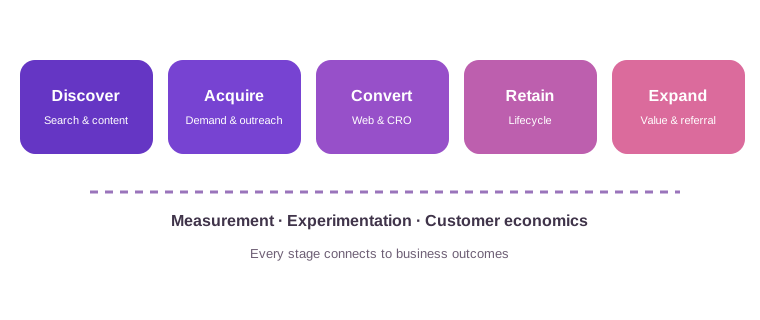
The GTMVerse Growth Model
The right foundation, connected capabilities and sound customer economics work together to create sustainable growth.
Layer | What it covers |
|---|---|
Foundation | Market understanding + Positioning + Validated product-market fitGrounded in customer research, business economics and a compelling offer |
Stage 01 | AcquisitionSEO · GEO · Paid · Outbound |
Stage 02 | ConversionWebsite · CRO · Sales enablement |
Stage 03 | RetentionLifecycle · Customer experience |
Stage 04 | ExpansionUpsell · Cross-sell · Advocacy |
Enablers | Experimentationanalyticsautomationprioritization |
Outcome | Sustainable revenue growthMeasured through CAC · LTV:CAC · Payback · Retention · Revenue |
The GTMVerse Growth Model is a strategic operating framework, not a literal mathematical equation. Product-market fit is validated by the business and its customers; marketing can help test and communicate the value proposition.
The growth formula: What should an agency actually own?
There isn't one universal formula that works for every company. A SaaS business, a D2C brand, and a local services company have different buying journeys, margins, sales cycles, and retention patterns. But most sustainable growth models come back to a few connected variables.
The customer growth equation
New customers = Qualified opportunities × Customer conversion rate
For an ecommerce business, qualified opportunities might mean purchase-intent sessions. For a B2B business, they might mean sales-qualified opportunities. For a local service company, they might mean qualified inquiries or bookings.
The definition changes, but the principle remains: growth depends on both the quantity and quality of demand, and the business's ability to convert it.
The revenue growth equation
Net revenue change = Revenue from new customers + Expansion and repeat revenue − Lost revenue
This simplified model helps explain why acquisition alone is not enough. A business can acquire more customers every month and still struggle if existing customers churn, margins deteriorate, or acquisition becomes unsustainable.
The sustainable growth equation
Sustainable growth = Customer acquisition × Conversion quality × Customer value × Retention efficiency
This is a conceptual model, not a mathematically precise accounting identity. The point is that the variables are connected. Improving one variable while damaging another doesn't necessarily improve the business.
For example, a campaign might double lead volume while reducing the percentage of leads that become customers. The marketing dashboard looks better, but the commercial outcome may not. A growth agency should understand those trade-offs.
Why LTV matters more than CAC alone
Customer acquisition cost tells you how much it costs to acquire a customer. That's useful, but incomplete.
Imagine two companies:
Metric | Company A | Company B |
|---|---|---|
Customer acquisition cost | $200 | $500 |
Customer lifetime value | $300 | $2,500 |
LTV:CAC ratio | 1.5:1 | 5:1 |
Illustrative figures, not industry benchmarks.
Company A acquires customers more cheaply. But Company B potentially has much stronger acquisition economics.
That doesn't automatically make Company B the better business. We also need to understand gross margins, cash flow, payback periods, customer retention, and how LTV was calculated. Comparing revenue-based LTV with fully loaded CAC can make the ratio misleading. A more useful approach often considers gross-profit-based customer value.
The cheapest customer isn't always the most valuable customer.
A growth agency that only optimizes cost per lead or CAC can make the wrong decisions. It should also understand:
- LTV:CAC ratio: Is customer value sufficient relative to acquisition cost?
- CAC payback: How long does it take to recover acquisition investment?
- Gross margin: How much value remains after delivery costs?
- Retention and churn: Are customers staying long enough?
- Pipeline quality and win rate: Are opportunities becoming customers?
- Incremental contribution: Would some results have occurred without the investment?
These metrics move the conversation from marketing performance to business performance.
A growth agency should know what NOT to do
One of the most valuable qualities in a growth partner is prioritization.
Not every business needs SEO, paid media, outbound, social media, email marketing, and a new website at the same time. And not every channel deserves equal investment.
Consider a company with strong organic traffic but poor website conversion. Should it immediately invest in producing another 50 articles? Maybe not.
Or consider a B2B company generating plenty of demo requests but struggling to close deals. Should it double its paid advertising budget? Probably not until it understands whether the problem is targeting, qualification, positioning, pricing, or the sales process.
The right growth strategy is often about removing the biggest constraint before increasing spending.
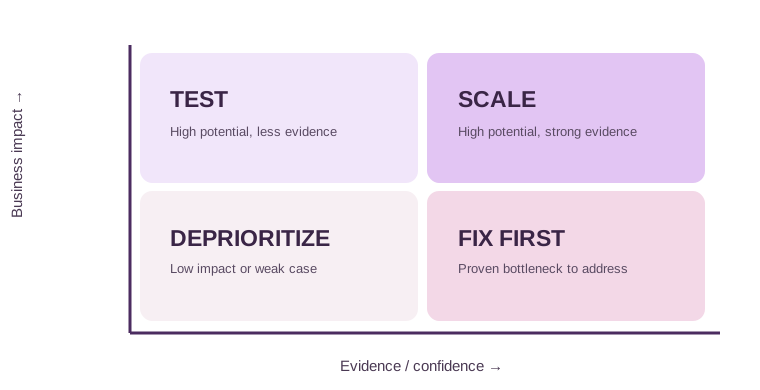
The GTMVerse Growth Prioritization Framework
Dimension | Question |
|---|---|
Business impact | Which revenue or customer metric could this improve? |
Evidence | What data supports the opportunity? |
Speed to learning | How quickly can we determine whether it works? |
Resource efficiency | What will it cost in time, money, and team capacity? |
Compounding potential | Will it create value beyond the immediate campaign? |
An initiative that scores well across these dimensions deserves attention. One that's expensive, difficult to measure, and disconnected from the current constraint should probably wait.
Deprioritization is a growth skill.
It's easy for an agency to recommend more campaigns. It's harder—and often more valuable—to explain why a business should stop investing in something.
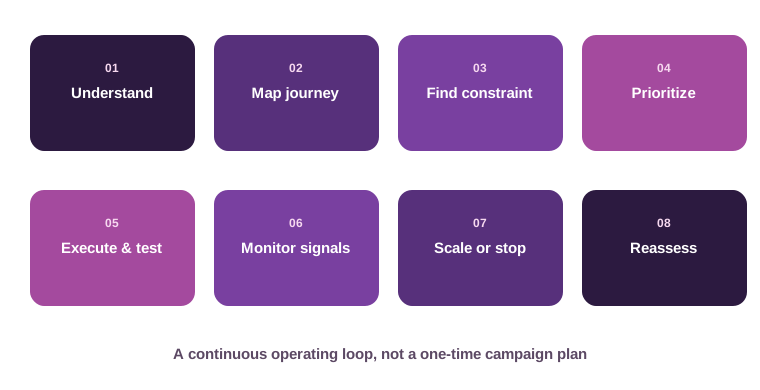
The GTMVerse Growth Operating Framework: From diagnosis to decisions
A good growth strategy needs more than a list of channels. It needs a repeatable operating process. I've found that the most useful approach is to start with the business problem, not the marketing activity.
- Understand the business. Start with the model, customer segments, revenue goals, margins, sales cycle, retention, and performance.
- Map the customer journey. Understand how customers discover, evaluate, purchase, and continue using the offering.
- Identify the growth constraint. Is it demand, qualification, conversion, sales execution, or retention?
- Prioritize the opportunities. Evaluate impact, evidence, learning speed, resources, and compounding value.
- Execute and experiment. Implement promising initiatives with hypotheses, ownership, and measurement.
- Monitor early signals. Detect meaningful changes before they become larger problems.
- Scale, improve, or stop. Increase investment when evidence supports it, refine promising work, and end weak initiatives.
- Reassess and repeat. As the business improves, the constraint changes.
Growth isn't a fixed campaign plan. It's a continuous cycle of better decisions.
Growth marketing services: channels are tools, not the strategy
Product marketing and go-to-market strategy
Product marketing clarifies who the business serves, what customers value, why they should choose it and how that value is communicated. It includes ICP research, segmentation, positioning, messaging, competitive analysis, pricing and packaging, launches and sales enablement. It is a key capability—not the only capability—in a connected growth strategy.
SEO
Technical SEO, search-intent research, content, internal linking and authority development improve relevant organic discovery. The objective is qualified demand, not rankings alone.
GEO and AI-search visibility
GEO improves factual clarity, source credibility, structured information and topical coverage for AI-assisted discovery. No agency can guarantee inclusion in AI-generated answers.
Paid media and performance marketing
Paid search and social can accelerate validated opportunities. Strong execution connects audiences, creative, landing pages, tracking and downstream customer economics.
Outbound and demand generation
Relevant account research, segmentation, compliant outreach, sales development and CRM handoffs help B2B teams engage potential buyers proactively.
Content marketing
Useful guides, comparisons, case studies, videos and product content help customers research and decide. Publishing volume is not the goal.
Website design and development
Websites connect attention to action. Positioning, information architecture, design, accessibility, performance, engineering quality and conversion flows all matter.
Conversion rate optimization
CRO improves meaningful conversion through user research, messaging, landing pages, forms, usability and appropriate experiments. Quality matters as much as quantity.
Lifecycle marketing and automation
Onboarding, nurturing, reactivation and retention programs extend customer value when based on reliable data and appropriate consent.
Analytics, attribution and experimentation
Connect activity to business outcomes through analytics, CRM reporting, tracking and testing. Attribution is imperfect; good decisions acknowledge uncertainty.
Growth marketing vs. digital marketing
These aren’t mutually exclusive categories. A digital marketing agency can be commercially accountable and experiment-driven. The distinction is the operating approach, not the label.
Dimension | Channel-focused approach | Full-funnel growth approach |
|---|---|---|
Objective | Campaign or channel outcomes | Connected customer and business outcomes |
Strategy | Organized by channel | Organized around constraints and journeys |
Measurement | Traffic, engagement, leads | Also CAC, LTV, pipeline, retention, revenue |
Optimization | Individual channel performance | Downstream economics and cross-channel effects |
B2B, D2C and local services need different growth models
B2B | D2C | Local services | |
|---|---|---|---|
Acquisition | SEO, outbound, paid, partnerships | Search, social, SEO, creators | Local SEO, Google Ads, referrals |
Conversion | Demo, trial, qualified opportunity | Purchase | Call, inquiry, booking |
Economics | CAC, payback, win rate, pipeline | CAC, AOV, margin, repeat purchase | Cost per customer, job value, repeat work |
Common bottleneck | Lead quality or sales conversion | Acquisition profitability | Inquiry-to-booking conversion |
A B2B company may need to improve qualification before buying more traffic. A D2C brand may need better margins and repeat purchasing. A local service company may need faster call response before spending more on ads. Same discipline; different levers.
The best growth agencies don't wait for campaigns to fail
Traditional campaign management often follows a familiar pattern: launch a campaign, wait for the reporting period, review performance, make adjustments.
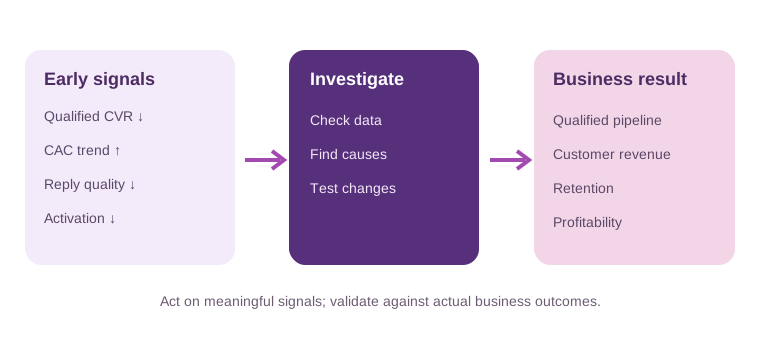
But by the time the results are clearly poor, the company may already have wasted significant budget or lost valuable opportunities. A more proactive growth team builds early-warning signals into its operating process.
- Paid media: If cost per qualified opportunity rises while downstream conversion falls, investigate audience quality, creative fatigue, landing-page performance, and attribution before increasing spend.
- SEO: If priority pages lose visibility, investigate technical changes, content relevance, search intent, competition, and search-result changes.
- Outbound: If positive reply rates decline, review account selection, message relevance, deliverability, and offer quality before scaling outreach.
- Website conversion: If qualified traffic remains stable but booking completion falls, investigate forms, page performance, messaging, and user behavior.
- Retention: If new customer cohorts show weaker early engagement, investigate onboarding and customer experience.
The goal isn't to predict the future perfectly. It's to build a system that detects meaningful changes early enough to act.
Leading indicators versus lagging outcomes
Leading indicators include qualified engagement, conversion progression, opportunity creation, onboarding completion, and early retention behavior.
Lagging outcomes include closed revenue, customer lifetime value, profitability, and long-term retention.
Leading indicators help teams make earlier decisions. Lagging outcomes determine whether those decisions ultimately created value. Neither should be interpreted in isolation.
Nine qualities to look for when hiring a growth marketing agency
If I were evaluating a growth partner, these are the capabilities I’d look for. None is sufficient alone.
- Business and revenue understanding: asks about margins, customers, economics and sales cycles.
- Strategy and prioritization: knows what to invest in—and what to stop.
- Product marketing and positioning: understands the ICP, differentiation, messaging and go-to-market.
- Hands-on cross-channel execution: can build and improve what it recommends.
- Growth economics: understands CAC, LTV:CAC, payback, retention and contribution margin.
- Experimentation and proactive optimization: identifies signals and adjusts before avoidable losses grow.
- Connected growth systems: integrates channels, CRM, analytics, signals and automation.
- Experience-backed playbooks: adapts proven processes to the actual business.
- Commercial accountability: explains ownership, evidence, uncertainty and trade-offs.
Interactive hiring scorecard
Use this checklist when comparing agencies. It is a discussion aid, not an objective certification.
Ten questions I’d ask
- What is our biggest growth constraint?
- Which business metrics matter most?
- How would you evaluate our customer acquisition economics?
- Which channels would you avoid initially?
- What would you prioritize in the first 90 days?
- What has your delivery team actually built?
- How do you connect marketing to revenue?
- Which early warning signals do you monitor?
- Can you show verified, relevant results?
- What would make you stop a campaign?
The 2027 shift: Growth marketing is becoming a signal-driven discipline
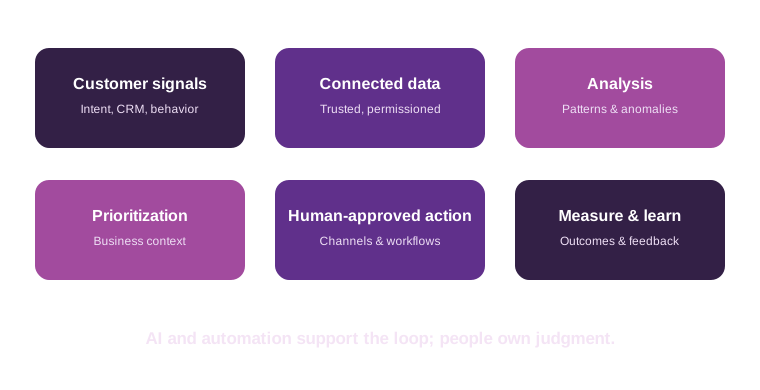
As we approach 2027, I believe one of the biggest changes in growth marketing will be the shift from managing isolated campaigns to operating connected systems of customer signals, decisions, and actions.
AI is already changing how customers discover information, how teams produce content, how campaigns are optimized, and how businesses analyze performance. But simply adding AI tools won't create a competitive advantage.
The advantage will come from connecting useful data to better decisions.
1. From channel dashboards to customer signals
A business might know that someone visited its website, engaged with a campaign, attended an event, or requested a demo. But those signals often sit in separate systems.
The opportunity is to connect them into a more useful picture of customer intent and progression. A B2B company might combine consented first-party website activity, CRM stage changes, campaign engagement, and event interactions to prioritize follow-up. A local service company might connect inquiries, booking outcomes, geographic demand, and response times.
The important shift is from collecting more data to making existing data actionable.
2. From fixed campaigns to adaptive execution
Buyer behavior, channel costs, competition, and conversion performance change. More capable growth systems will monitor meaningful indicators and trigger reviews or adjustments when conditions move outside expected ranges. Significant decisions still need appropriate human oversight.
3. From more automation to better automation
Automation helps when it removes repetitive work or improves the timeliness of a valuable action. It becomes harmful when it amplifies poor targeting, irrelevant messages, inaccurate data, or weak customer experiences.
The question isn't "How much can we automate?" It's "Which decisions and actions become more reliable, timely, and valuable when automated?"
4. From AI-generated volume to differentiated expertise
AI makes it easier to produce content, ads, reports, and campaign variations. That increases the importance of original experience, useful research, accurate information, strong positioning, and creative judgment. Producing more content won't necessarily create more demand.
5. From reporting results to recommending the next move
A dashboard can tell you conversion rates declined. A stronger growth operating system helps investigate why, identify plausible causes, recommend the next experiment, and track whether the intervention worked.
My perspective on 2027
I don't believe the best growth marketing agencies will be the ones using the largest number of AI tools. I believe they'll combine business understanding + customer signals + hands-on execution + experimentation + automation + human judgment.
This is a strategic outlook, not a guaranteed forecast. The pace of change will differ across industries and business models.
What should happen in the first 90 days?
- Days 1–30 — Diagnose: Understand the model, positioning, customer journey, performance and economics. Establish baselines and constraints.
- Days 31–60 — Execute and learn: Implement prioritized improvements, launch relevant experiments and connect measurement.
- Days 61–90 — Evaluate and decide: Identify what works, what needs improvement and what should stop or scale.
- Beyond day 90 — Compound: Repeat the operating rhythm as constraints change and longer-cycle programs mature.
Not every channel should be expected to deliver revenue within 90 days. SEO and long B2B sales cycles may require longer. The first milestone is a credible, repeatable operating rhythm.
How much does a growth marketing agency cost?
There is no universal price. Scope, channels, competition, geography, creative and technical requirements, and strategic involvement all affect fees.
Common models include monthly retainers, project-based engagements, performance-linked fees and hybrid arrangements. Advertising spend, tools and third-party production may be separate.
I’d compare agencies on scope, delivery ownership, measurement, commercial assumptions and expected value—not retainer size alone.
Final thought: hire a growth partner, not just a campaign manager
After years of working across growth functions, one belief has stayed with me: growth isn’t about doing everything. It’s about knowing what matters most and executing it well.
Sometimes that means SEO. Sometimes paid acquisition, a stronger website, better positioning, faster sales follow-up or improved retention. And sometimes the right decision is to stop an initiative that isn’t earning its place.
The objective isn’t more marketing activity. It’s a business that acquires valuable customers, converts them effectively, retains them longer and grows more sustainably.
That’s how I think about growth marketing—and the thinking behind GTMVerse.