Your customers are asking ChatGPT to compare products, recommend software, evaluate vendors, and explain buying decisions. How do you make your website eligible to appear, earn citations, and become relevant to those answers?
The answer is not a secret schema trick or a fixed number of Reddit mentions. It starts with crawler access, useful information, independent evidence, and measurement that distinguishes citations, brand mentions, recommendations, and conversions.
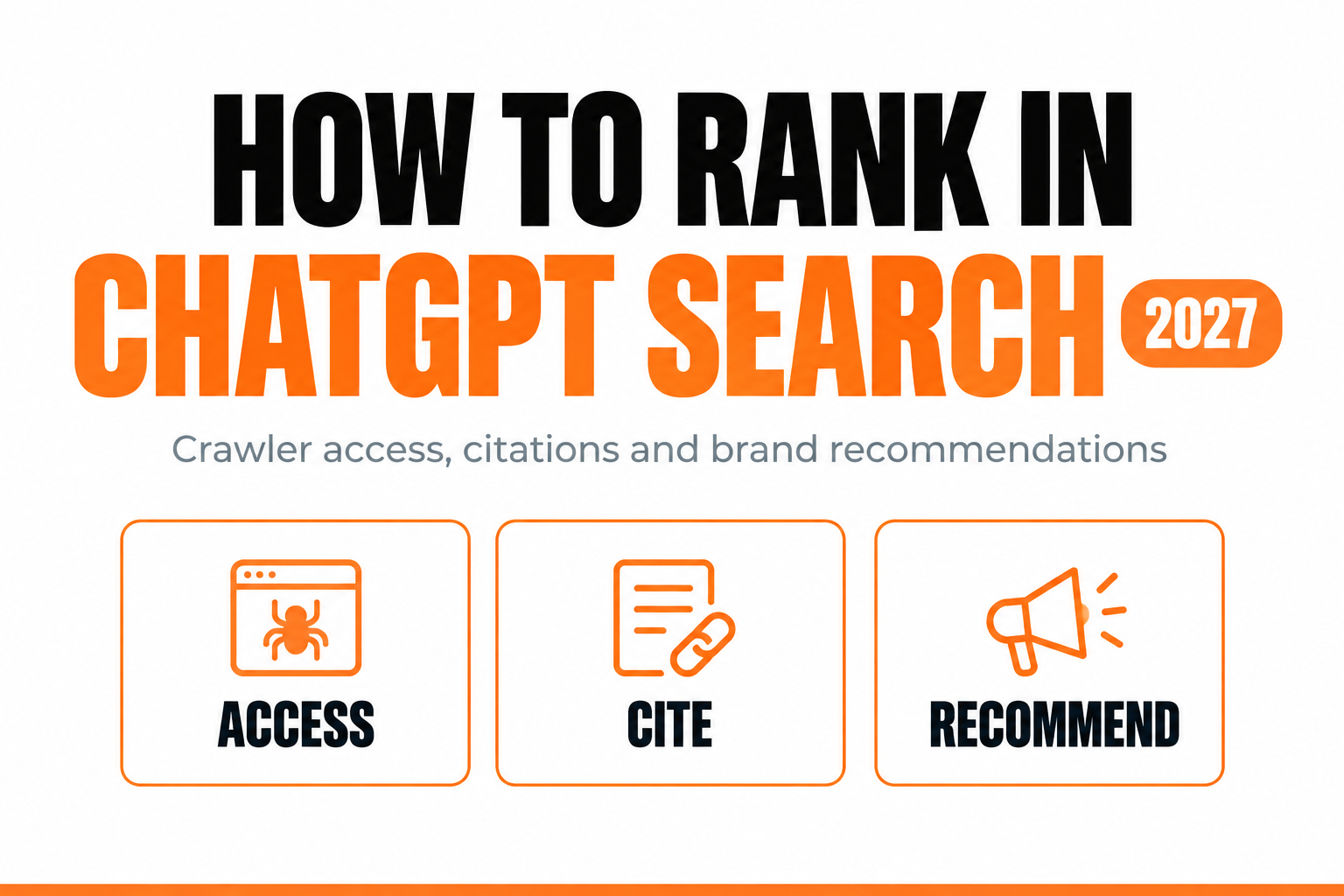
Direct answer: To improve visibility in ChatGPT Search, allow OAI-SearchBot, verify that your firewall does not block verified crawler traffic, maintain accessible and relevant pages, publish original evidence, earn legitimate external references, and track citations and recommendations across repeated prompt tests. None of these actions guarantees placement.
What is ChatGPT SEO?
ChatGPT SEO is the practice of improving a website’s accessibility, discoverability, relevance, and usefulness for ChatGPT Search, with the goal of increasing qualified visibility through citations, mentions, recommendations, and referrals.
Term | Primary focus |
|---|---|
SEO | Traditional organic search visibility |
ChatGPT SEO | Visibility within ChatGPT Search |
AI SEO | Broader AI-search optimization and AI-assisted SEO |
GEO | Visibility in generative answer experiences |
AEO | Answer-focused content and discoverability |
These labels overlap and are not universally standardized. This guide focuses specifically on ChatGPT Search while identifying where conventional SEO and broader GEO practices overlap.
How to Rank in ChatGPT Search: 10 Practical Steps
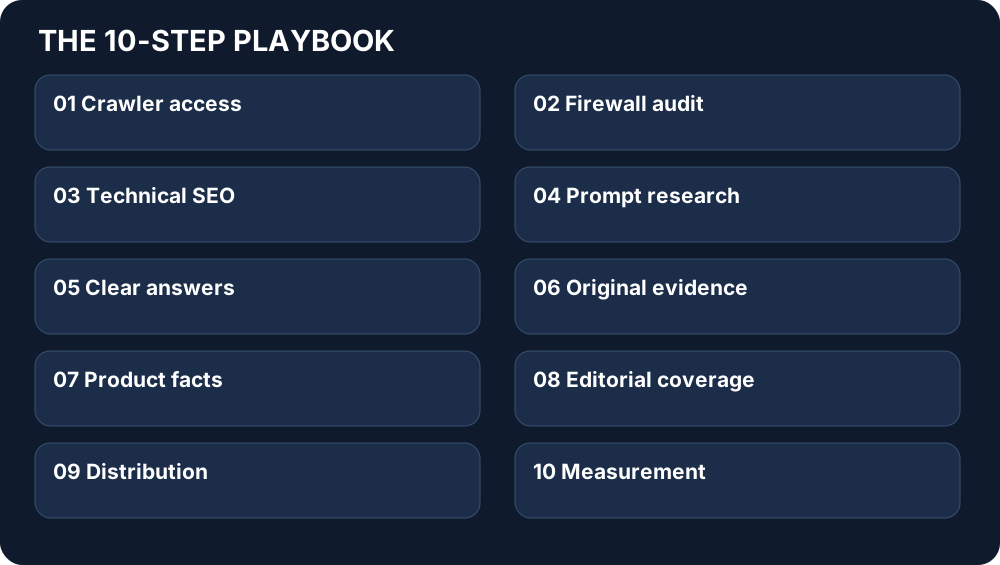
Step | Action | How to verify |
|---|---|---|
1 | Allow OAI-SearchBot | Robots policy and verified access |
2 | Audit Cloudflare and your firewall | Security events and HTTP response |
3 | Fix technical SEO | Canonical URLs, internal links, HTML |
4 | Research buyer prompts | Intent-mapped prompt library |
5 | Answer questions clearly | Relevant, factual content |
6 | Publish original evidence | Methods, screenshots, limitations |
7 | Maintain product facts | Pricing and capability consistency |
8 | Earn independent coverage | Genuine editorial reviews |
9 | Distribute useful research | Qualified pickup and referrals |
10 | Measure repeatedly | Citations, mentions, conversions |
These are recommended actions, not ten confirmed internal ranking factors. The following sections explain how to implement and test them.
How ChatGPT Search Visibility Actually Works
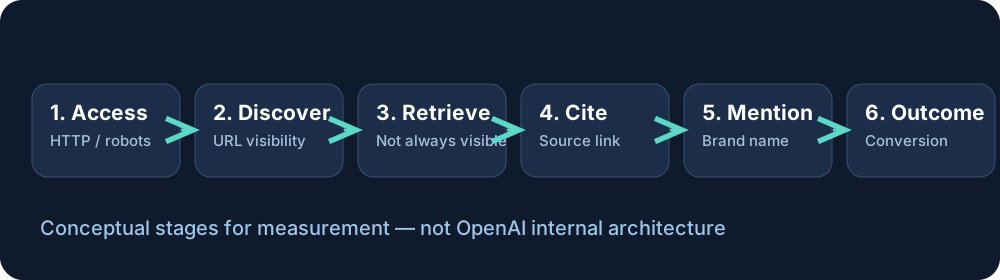
ChatGPT may search the web, rewrite a user question into more targeted queries, use external search providers, and synthesize an answer. The precise retrieval and ranking implementation is not fully public.
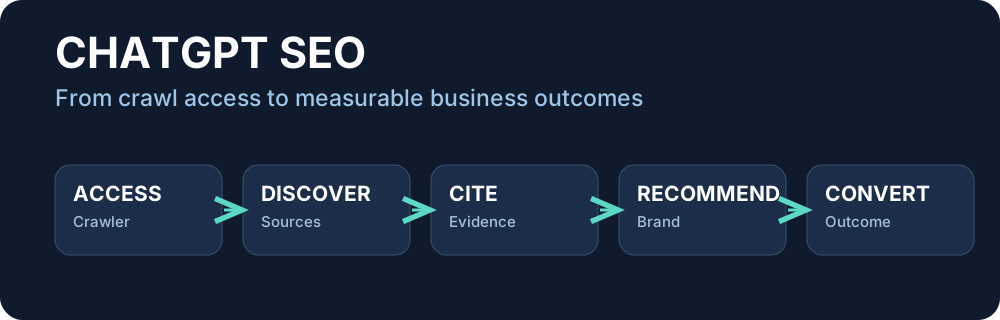
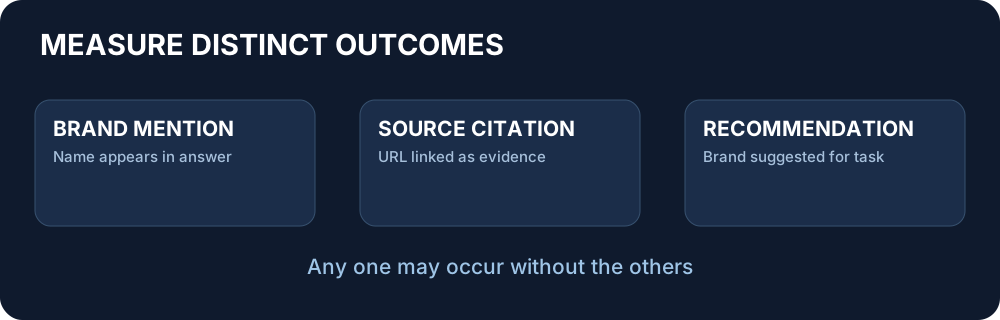
Our model distinguishes access → discovery → retrieval → citation / mention / recommendation → business outcome. These are analytical stages, not a claim about OpenAI’s internal architecture. A brand can be recommended without an owned-domain citation; a source can be cited without being recommended.
Technical ChatGPT SEO: OAI-SearchBot, Robots.txt and Cloudflare
1. Configure crawler access
OpenAI documents OAI-SearchBot for search discovery and GPTBot for a different crawling purpose. Website owners can make separate decisions about them. Review the official crawler documentation before changing production policies.
User-agent: OAI-SearchBot
Allow: /
This example is illustrative; it should not overwrite existing path restrictions or other directives. Allowing the bot does not guarantee citations.
2. Inspect CDN and firewall behavior
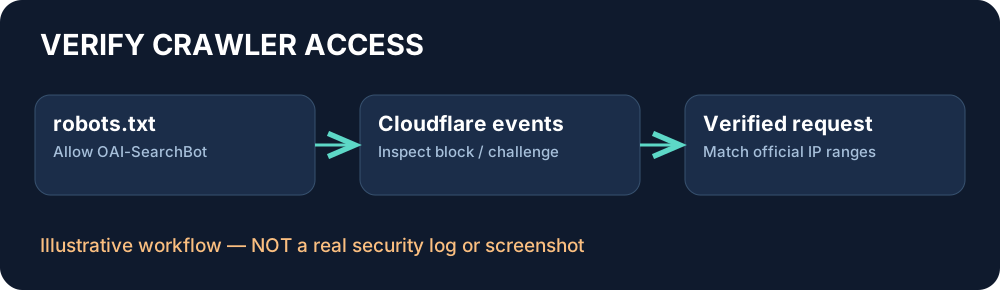
A crawler may be permitted in robots.txt yet encounter a 403, rate limit, bot challenge, or origin restriction. Check real security events and response logs. Match IPs against OpenAI’s published crawler ranges. Do not allow arbitrary traffic based solely on the spoofable user-agent string.
curl -I -A "OAI-SearchBot" https://example.com/
This command only tests how your server responds to a declared user-agent. It does not authenticate an OpenAI crawler.
3. Fix foundational SEO
Use canonical URLs, meaningful internal links, accessible HTML, clear headings, reliable HTTP responses, appropriate indexability directives, and accurate XML sitemaps. Ensure critical content is not hidden behind login or fragile rendering.
Is Brave or Google Indexing Required for ChatGPT?
There is no publicly established universal requirement that a website must be indexed in Brave Search to appear in ChatGPT Search. Brave operates an independent index and provides search services, but that does not prove every ChatGPT result depends on Brave.
Similarly, indexing in Google or Bing is not a documented universal prerequisite for ChatGPT citations. Monitor those systems for broader discoverability, but keep their index status separate from actual ChatGPT observations.
IndexNow is a notification protocol, not an indexing guarantee. See official IndexNow documentation.
From Keyword Research to Prompt-Intent Architecture
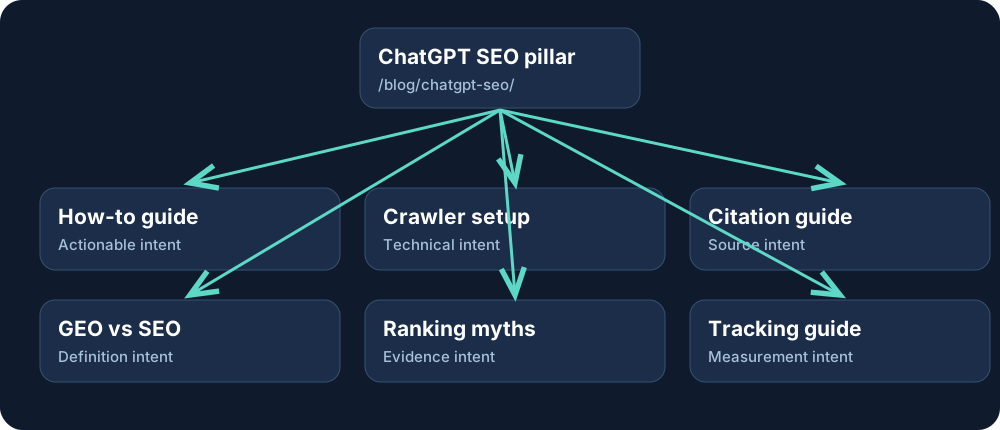
A question like “What is a digital business card?” requires a definition. “Which digital business card helps me capture conversations at events?” requires product evaluation. Map pages to distinct tasks rather than creating thin URLs for every prompt variation.
Intent | Example prompt | Best supporting content |
|---|---|---|
Definition | What is a digital business card? | Clear explanation |
How-to | How do I create one? | Tested walkthrough |
Comparison | Product A vs Product B? | Verified differences |
Recommendation | Best option for event networking? | Use-case evidence and limitations |
Pricing | How much does it cost? | Current pricing and plan limits |
Troubleshooting | Why is my QR code not working? | Specific diagnostics |
Preserve one primary commercial page for the central product intent and support it with genuinely distinct guides, comparisons, technical references, and original research.
How to Create Content Worth Citing
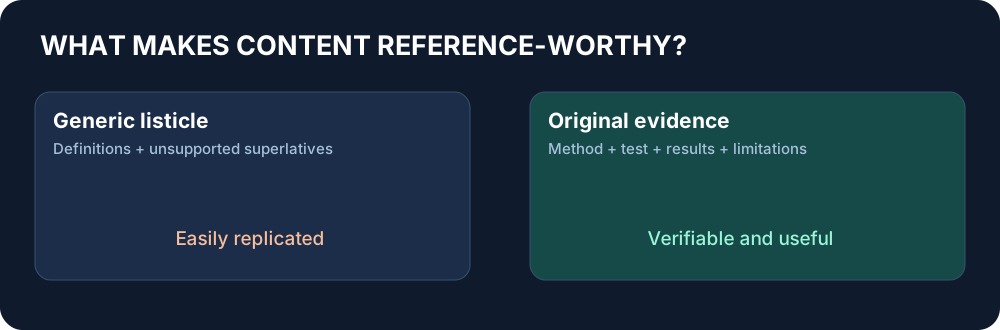
Originality is not a magical ranking signal. But firsthand tests, transparent methods, real screenshots, documented limitations, and accurate data produce information that other readers and publishers can verify.
For product research, record the test date, devices, versions, evaluation criteria, observed outcomes, and failures. Avoid unsupported superlatives. Cite primary sources for technical claims. Keep factual information visible in HTML rather than available only inside images.
How to Improve Brand Recommendations and Third-Party Evidence
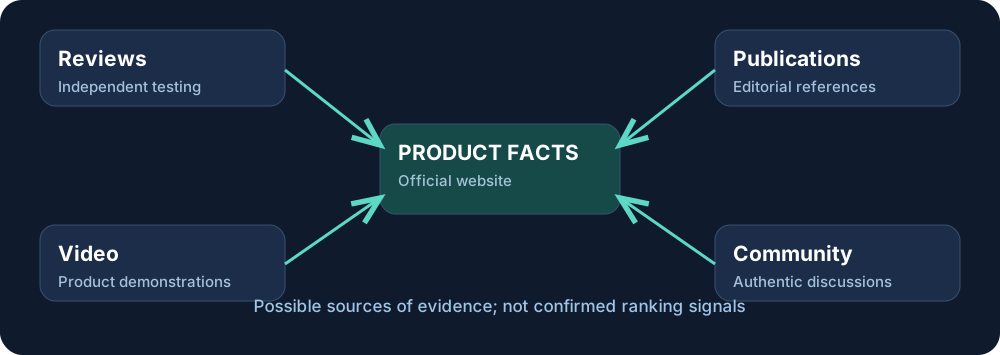
A brand mention is not a recommendation, and a recommendation is not an endorsement by the platform. Keep product identity, pricing, availability, integrations, and limitations consistent. Pursue genuine independent reviews and editorial coverage; do not manufacture reviews or spam communities.
Backlinks have an established role in conventional Google SEO, but third-party Domain Rating and social likes are not documented ChatGPT ranking factors. Treat external coverage as discoverability, evidence, and referral opportunities rather than a guaranteed recommendation mechanism.
Structured Data and llms.txt: What Is Actually Known
Valid Organization, SoftwareApplication, Article, BreadcrumbList, and VideoObject markup can describe content to systems that support those schemas. Ensure markup reflects visible facts. No general schema type is established as a guaranteed ChatGPT citation switch.
Likewise, llms.txt is a proposed convention used by some systems, not a documented requirement for ChatGPT Search inclusion. Prioritize proven access and content problems before speculative additions.
Google’s AI features guidance emphasizes foundational SEO and does not establish a special AI-only markup requirement for Google AI Overviews and AI Mode. Google-specific guidance should not be misrepresented as OpenAI’s internal ranking specification.
40 ChatGPT Ranking Claims: Evidence vs. Myths
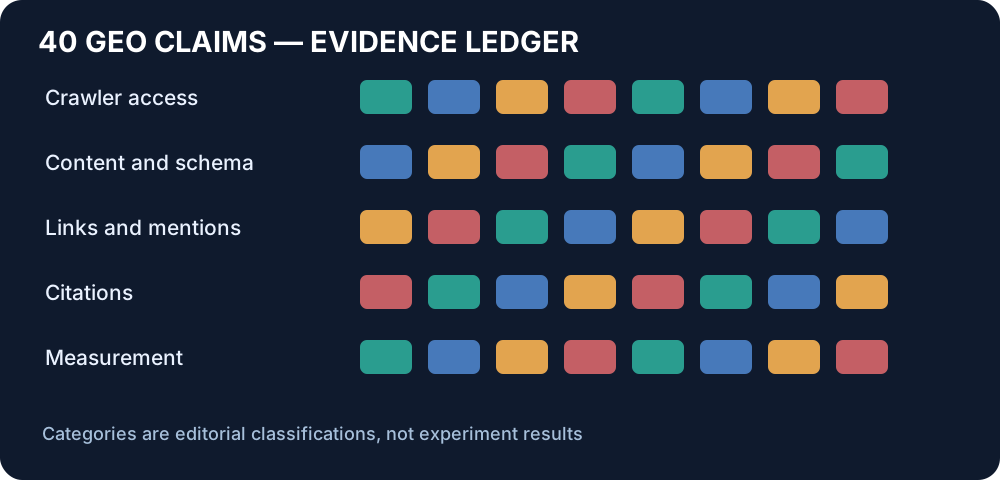
Evidence labels: Documented = official relevant documentation; Established = recognized technical or methodological practice; Observable = visible behavior; Hypothesis = plausible but not proven; Unsupported / Incorrect = not substantiated as stated. The ledger is an editorial assessment, not 40 completed experiments.
Crawling and indexing
Claim | Assessment |
|---|---|
OAI-SearchBot supports ChatGPT Search discovery | Documented |
Allowing OAI-SearchBot guarantees citations | Unsupported |
GPTBot and OAI-SearchBot serve identical purposes | Incorrect |
CDN rules can block permitted crawler requests | Established |
A user-agent curl test verifies OpenAI identity | Incorrect |
Brave indexing is mandatory for ChatGPT | Unsupported |
XML sitemaps support conventional URL discovery | Documented |
IndexNow guarantees indexing | Incorrect |
Content and schema
Claim | Assessment |
|---|---|
Clear answers improve usefulness | Editorial practice |
Keyword repetition guarantees AI ranking | Unsupported |
Schema guarantees ChatGPT citations | Unsupported |
Schema should match visible content | Documented Google guidance |
Every prompt variant needs its own page | Unsupported |
Original tests create differentiated evidence | Editorial practice |
Freshness always beats relevance | Unsupported |
AI-generated content is automatically ineligible | Unsupported |
Links and authority
Claim | Assessment |
|---|---|
Google uses link-based signals | Documented |
Domain Rating is a ChatGPT ranking factor | Unsupported |
Every unlinked mention improves AI ranking | Unsupported |
Independent reviews provide external evidence | Established |
LinkedIn likes directly boost ChatGPT ranking | Unsupported |
Reddit comment volume is a direct ranking factor | Unsupported |
YouTube can distribute product demonstrations | Established |
Paid directory links guarantee recommendations | Unsupported |
Citations and recommendations
Claim | Assessment |
|---|---|
Brand mentions and citations differ | Observable |
Every cited brand is recommended | Incorrect |
Recommendations can lack owned-domain citations | Observable |
ChatGPT cites every source it examines | Unsupported |
One citation proves stable ranking | Incorrect |
Consistent facts may reduce contradictions | Hypothesis |
Independent coverage guarantees recommendations | Unsupported |
A universal ChatGPT ranking formula is public | Unsupported |
Measurement and experimentation
Claim | Assessment |
|---|---|
Prompt wording can change responses | Observable |
Repeated prompts can measure observed visibility | Methodological |
One prompt run establishes causation | Incorrect |
Citation and recommendation rates should differ | Methodological |
Referral analytics capture all AI discovery | Unsupported |
Before-after changes alone prove causation | Incorrect |
Control groups strengthen experiments | Established |
Every GEO change must immediately move results | Unsupported |
How to Track ChatGPT SEO, Citations and Recommendations
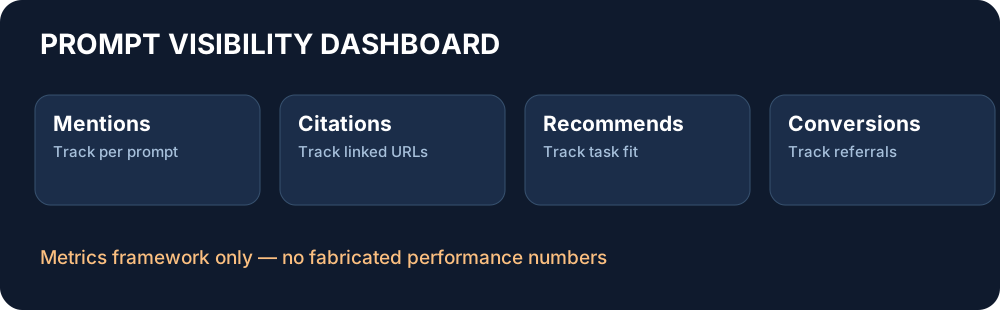
Create a representative library of 50–100 prompts spanning definitions, comparisons, recommendations, pricing, and troubleshooting. Record exact prompt text, date, model/search configuration, mentioned brands, recommended brands, cited URLs, errors, and run identifier. Repeat tests under a consistent protocol.
Metric | Definition |
|---|---|
Brand mention rate | Responses mentioning the brand / evaluated responses |
Recommendation rate | Responses recommending brand / recommendation-eligible responses |
Owned-domain citation rate | Responses citing your domain / evaluated responses |
Qualified referral conversion rate | Conversions / identifiable AI-referred sessions |
These are operational metrics, not official OpenAI rankings. Referral attribution is incomplete: AI discovery can lead to direct or branded-search visits without a trackable citation click.
How to Run a Reproducible GEO Experiment
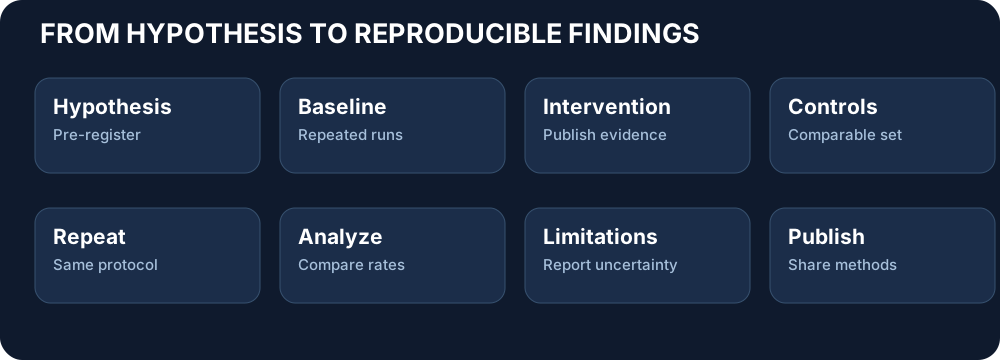
Pre-register a hypothesis, record a baseline across repeated prompts, make one clearly defined intervention, retain comparable controls where possible, and re-evaluate with the same protocol. Report negative and inconclusive results alongside successes.
Example hypothesis: publishing an original, documented product test increases citations for evidence-seeking prompts. An increase after publication is an observation, not automatic proof of causality; search updates, competing pages, prompt variability, and other marketing activities can confound results.
What Is Changing in AI SEO for 2027?
2027 readiness is not a prediction that Google rankings disappear. Conventional search and AI-generated answers will coexist. The strategic shift is that discovery may happen across a sequence of questions, comparisons and actions rather than a single query and click. The following are planning scenarios and emerging workflows, not confirmed new ChatGPT ranking factors.
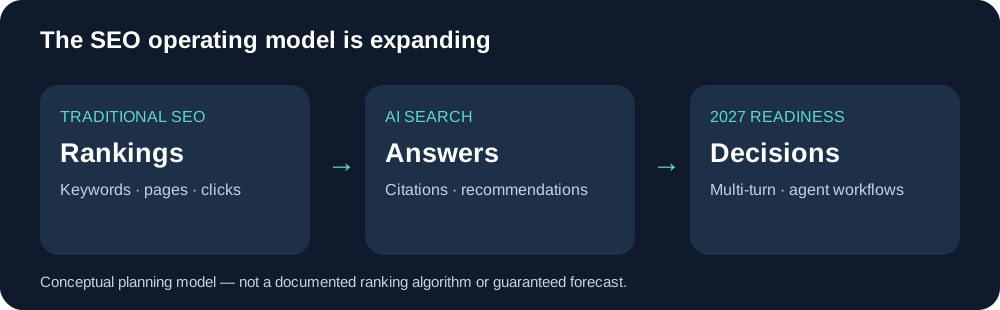
1. Optimize for multi-turn buyer journeys
A buyer may begin with “best digital business cards,” then ask about privacy, pricing, CRM integration, and event workflows. Test connected follow-up questions as well as isolated prompts. Record whether recommendations persist, change, or disappear when constraints become more specific.
2. Prepare for agent-assisted discovery and actions
AI assistants may increasingly help users compare offerings and complete tasks. Keep public product facts, support documentation, pricing, integrations, and conversion workflows accurate and accessible. For APIs or action-oriented integrations, prioritize reliable documentation, permissions and security. This is a preparation strategy, not a claim that agent readiness is a confirmed ranking signal.
3. Invest in evidence that generic content cannot replicate
Publish firsthand tests, reproducible benchmarks, dated screenshots, methods, and honest limitations. The goal is to create useful reference material rather than generate more undifferentiated summaries.
4. Maintain a trustworthy brand-information ecosystem
Audit your official site, product listings, credible independent reviews, and documentation for conflicting claims. Correct errors where you control the information; seek genuine editorial corrections where you do not.
5. Measure visibility across an entire decision journey
Track mentions, citations, recommendations, and qualified business outcomes separately. Add a cohort of multi-turn prompts and compare results over time. Don't infer a stable ranking from one answer.
6. Build a governance process for changing platform behavior
Review OpenAI and Google documentation quarterly. Maintain a change log that distinguishes newly documented capabilities from practitioner hypotheses and observed experiments.
The 2027 ChatGPT SEO Readiness Checklist
Use this as a practical audit. These are implementation priorities, not official ranking factors.
- Verify OAI-SearchBot permissions and real crawler access
- Check CDN, firewall, server status and key public pages
- Confirm canonical URLs, sitemaps and internal linking
- Establish a repeatable 50–100-prompt benchmark
- Add multi-turn product evaluation scenarios
- Audit product capabilities, integrations and pricing accuracy
- Publish at least one original, documented evidence asset
- Earn credible independent reviews or editorial references
- Separate citations, mentions, recommendations and conversions
- Schedule quarterly documentation and evidence reviews
Publication note: This is a 2027 edition published in November 2026. It does not claim that future 2027 platform changes have already occurred. Update the actual review date only after substantive verification.
The 90-Day ChatGPT SEO Roadmap for 2027
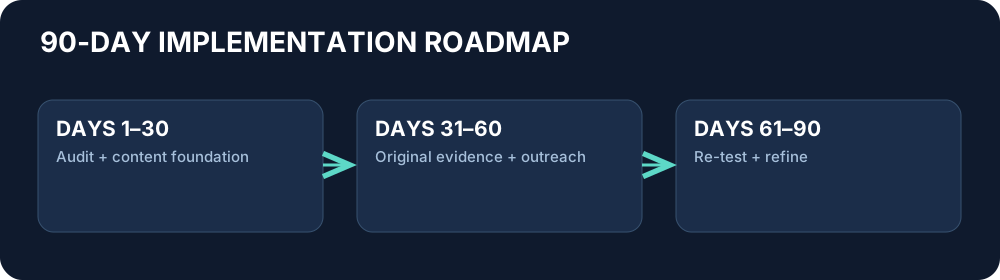
Window | Priority | Deliverable |
|---|---|---|
Days 1–15 | Access and baseline | Crawler audit + prompt evaluation set |
Days 16–30 | Content and evidence | Commercial page improvements + original test |
Days 31–60 | Independent discovery | Editorial outreach + useful distribution |
Days 61–90 | Repeat and refine | Citation, recommendation and conversion analysis |
Ninety days is a planning window, not a guaranteed time to rank.
The Future of ChatGPT SEO
For 2027, prepare for both conventional organic search and conversational discovery. Prioritize accessible pages, credible evidence, accurate product information, multi-turn testing, and measurable customer outcomes. Treat agent-assisted buying as a scenario to prepare for—not a guaranteed shift or ranking signal.
AI search changes what we can observe and measure, but it does not eliminate the value of technical accessibility, useful content, and trustworthy evidence.
A page can be accessible without being cited. A brand can be mentioned without being recommended. A citation can occur without a visit. Sustainable optimization requires distinguishing these outcomes and testing improvements rather than repeating folklore.
Stop asking only how to rank in ChatGPT. Start asking what makes your information accessible, relevant, verifiable, and worth citing.
Sources and Research Methodology
- OpenAI — Overview of OpenAI Crawlers
- OpenAI — Searching the Web With ChatGPT
- OpenAI — Publishers and Developers FAQ
- Google — AI Features and Your Website
- IndexNow — Official Documentation
Research Methodology
This guide draws on official documentation from OpenAI and Google, established technical SEO practices, and observable AI search behavior. Recommendations are evaluated based on available evidence, with emerging techniques and unverified ranking claims clearly identified.
We periodically review this guide to reflect changes in AI search technology, platform documentation, and SEO best practices.