
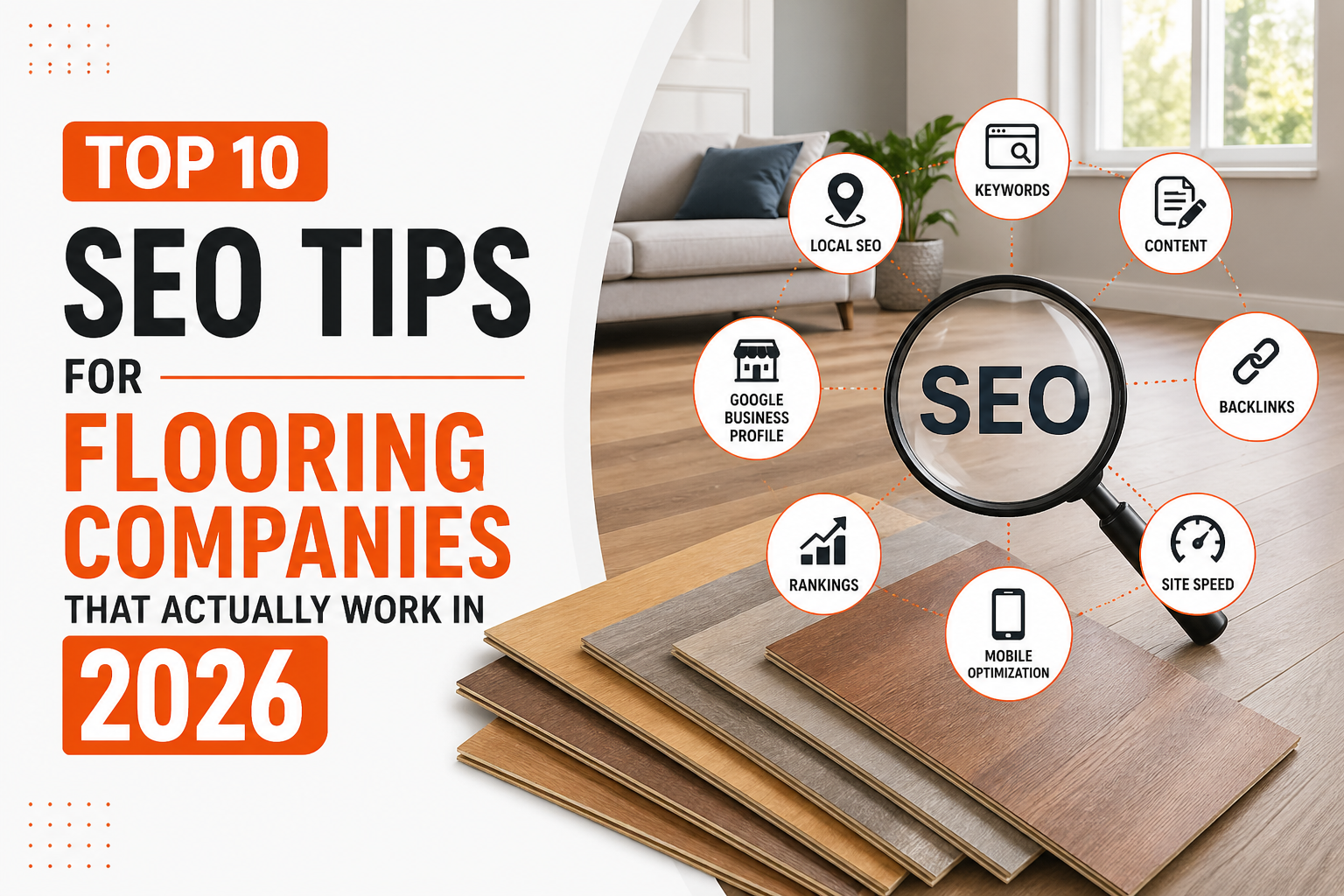

Most flooring companies are invisible online not because their work is poor, but because they are competing against national aggregator sites and franchise chains that have spent years building domain authority. Your showroom may be the best in the city. Your reviews might be impeccable. But if page one belongs to HomeAdvisor and Angi, you are funding their lead generation, not building your own.
These SEO tips for flooring companies are built for operators who want to own their pipeline - not rent it from directories.
Why Most Flooring Companies Struggle to Rank
The flooring industry is hyper-local by nature. A homeowner in Austin is not searching for a flooring contractor in Boston. That should make local SEO easier. Yet most flooring businesses either do not invest in SEO at all, or they invest in the wrong things like generic blogs, keyword-stuffed pages, or a website that has never been touched since 2019.
The result? The top three Google Map Pack positions are captured by directory listings - Houzz, Angi, Thumbtack and one or two well-optimized local competitors. The flooring company with superior craftsmanship sits on page two, where less than 1% of searchers ever scroll.
The SEO problem for flooring companies is not a content volume problem. It is a strategy problem. You need the right signals in the right places technical, content, and local. Here is exactly where to start.
1. Claim and Fully Optimize Your Google Business Profile
The Single Highest-ROI SEO Action for Flooring Companies
Your Google Business Profile (GBP) is the most important SEO asset a flooring company owns. It determines whether you appear in the local Map Pack the three business listings that appear above organic results for searches like 'flooring company near me.'
Complete every field. Choose the most specific primary category 'Flooring Store' or 'Flooring Contractor' rather than just 'Home Improvement.' Upload 20+ high-quality photos of your work, your showroom, and your team. Add your service areas, business hours, and a keyword-rich business description that naturally includes 'flooring installation,' your city name, and the materials you specialize in.
Post weekly updates using the GBP Posts feature. We have seen consistent GBP posting improve Map Pack rankings by moving flooring companies from position 4-7 into the top three within 90 days without any other changes.
2. Build Location-Specific Landing Pages
How Flooring Company SEO Strategy Wins in Multi-City Markets
If you serve multiple cities or neighborhoods, one homepage is not enough. Google ranks pages, not websites. A dedicated page for 'hardwood flooring installation in [City Name]' gives Google a clear, specific signal about your geographic relevance for that location.
Each location page should include: the city name in the H1 and page title, a unique description of your work in that area, embedded Google Map, local customer testimonials, and a clear call to action. Do not copy-paste the same content across locations - thin, duplicate location pages get filtered out of results, not ranked.
Across our content engagements, location-specific pages consistently outperform generic service pages in organic click-through - often by a factor of 3x to 5x when the page matches search intent precisely.
3. Target the Right SEO Keywords for Your Flooring Business
Think Revenue Intent, Not Just Search Volume
The biggest keyword mistake flooring companies make: chasing broad terms like 'flooring' or 'hardwood floors' that are dominated by national retailers. The better play is specificity long-tail, service-plus-location keywords that signal buying intent.
High-value keyword types for flooring website optimization:
- Service + location: 'tile flooring installation Dallas TX'
- Material + action: 'LVP flooring installation cost'
- Problem-aware: 'how to fix scratched hardwood floors'
- Comparison intent: 'hardwood vs LVP flooring pros and cons'
- Near-me variants: 'flooring contractor near me,' 'flooring store open now'
Map each keyword to a specific page on your site. One page should not try to rank for fifteen keywords. Focused pages with clear topical relevance rank faster and convert better.
4. Publish Content That Answers Buyer Questions
Content Is Your SEO Moat Flooring Companies That Blog Win More
A buyer researching flooring goes through a multi-week, multi-search journey. They ask questions like 'how much does hardwood flooring installation cost,' 'what is the most durable flooring for pets,' and 'how long does it take to install LVP flooring.' The company that answers those questions builds trust before the first phone call.
Publish at minimum two educational blog posts per month. Structure each post to answer one specific question completely not a list of surface-level tips, but a definitive resource that also links to your service pages and location pages. This is what we call the GTMVerse Content Ownership Model: you do not just create content, you own the answer for every question your buyer asks on the way to a decision.
Internal links from educational content to your 'Get a Free Quote' pages also distribute SEO authority through your site improving rankings for your most important conversion pages.
5. Earn and Manage Reviews Systematically
Reviews Are a Direct Local SEO Ranking Signal
Google's local ranking algorithm weighs review quantity, recency, and response rate. A flooring company with 12 reviews from 2021 will consistently lose the Map Pack to a competitor with 60 reviews updated this quarter even if the older company is technically better.
Build a systematic review generation process: send a follow-up text or email 48 hours after project completion with a direct link to your Google review page. Respond to every review positive and negative within 48 hours. When you respond to negative reviews professionally, you signal to both Google and prospective customers that you take quality seriously.
Target a minimum of 4 new reviews per month. Businesses that hit that cadence consistently see measurable improvement in their local pack positions within 60-90 days.
6. Fix Technical SEO on Your Flooring Website
A Slow, Broken Website Kills Flooring Contractor Search Rankings
Technical SEO is the foundation everything else sits on. The best content in your city cannot rank if Google cannot crawl your site efficiently or if your pages load in 8 seconds on mobile. Google's Core Web Vitals data shows that pages meeting 'Good' thresholds have significantly lower bounce rates and higher conversion rates than slow pages.
Priority technical fixes for flooring websites:
- Page speed: compress images (flooring photos are often massive), use a CDN, minimize render-blocking scripts
- Mobile optimization: over 60% of local service searches happen on mobile test every page
- HTTPS: an unencrypted site signals untrustworthiness to both Google and visitors
- Crawlability: submit an XML sitemap, fix broken links and 404 errors monthly
- Title tags and meta descriptions: unique, keyword-relevant tags on every page not WordPress defaults
7. Build Local Citations Consistently
NAP Consistency Is a Core Local SEO Signal
A citation is any online mention of your business Name, Address, and Phone number referred to as NAP. Google cross-references your NAP data across dozens of directories to validate that your business is legitimate and located where you say it is. Inconsistent NAP data (different phone numbers on Yelp vs. your website, for example) is a trust signal failure that suppresses rankings.
Audit your listings on Yelp, Angi, HomeAdvisor, Houzz, the Better Business Bureau, local Chamber of Commerce directories, and any industry-specific directories. Standardize your NAP across all of them. Then add structured citations on high-authority platforms you are currently missing.
8. Use Schema Markup to Stand Out in SERPs
Structured Data Gives Flooring Companies a SERP Advantage Most Skip
Schema markup is structured data code that tells search engines exactly what your page is about. For flooring companies, the right schema implementation can generate rich snippets star ratings, FAQs, service areas that appear directly in search results and dramatically increase click-through rates even when you are not in the top position.
Recommended schema types for flooring businesses:
- LocalBusiness schema: name, address, phone, geo coordinates, hours
- Service schema: list each flooring service (hardwood installation, tile installation, LVP) as a structured service object
- Review/AggregateRating schema: display your star rating in search results
- FAQPage schema: add to every blog post and service page with Q&A content
- Article schema: for all educational blog content
9. Build Backlinks From Local and Industry Sources
Authority Signals That Move Flooring Company Search Rankings
Links from other websites to yours remain one of the strongest ranking signals in Google's algorithm. For local businesses, relevance and local authority matter as much as raw quantity. A link from a respected local home builder's website carries more weight than a generic link from a content farm.
Practical backlink sources for flooring companies:
- Partner with local interior designers, real estate agents, and home builders get featured on their 'Preferred Vendors' pages
- Sponsor local home and garden shows or neighborhood association events that post sponsors online
- Submit your completed projects to local news and home improvement publications
- Earn supplier or manufacturer dealer listings (Shaw Floors, Mohawk, Armstrong all offer dealer directories)
- Guest post on local lifestyle or home renovation blogs
10. Track What Moves Revenue, Not Just Rankings
The Metric Most Flooring Businesses Forget in Their SEO Strategy
Rankings are a leading indicator, not the outcome. A flooring company that ranks #1 for a keyword that generates zero calls has a conversion problem, not an SEO win. The tracking framework has to connect search performance to actual revenue.
The minimum measurement stack for flooring SEO:
- Google Search Console: track impressions, clicks, and average position for your target keywords weekly
- Google Analytics 4: set up conversion events for phone call clicks, form submissions, and quote requests
- Google Business Profile Insights: track searches, direction requests, and calls from your GBP listing
- Call tracking: use a tracking number to attribute inbound calls to organic search specifically
- Monthly revenue attribution: how much of your closed revenue this month originated from organic traffic?
If you are not tracking organic-to-revenue attribution, you cannot make smart decisions about where to invest next in your SEO strategy.
How B2B SEO Strategy Fits (Even for Flooring Companies)
While flooring is a local service, parts of your business behave like B2B especially if you work with builders, architects, interior designers, or commercial projects. This is where a B2B SEO strategy becomes relevant.
Unlike local SEO (which targets “near me” searches), B2B SEO focuses on decision-stage content and high-value partnerships. For example, instead of just ranking for “flooring installation near me,” you can create pages like:
- “Commercial flooring solutions for office spaces”
- “Flooring contractor for builders in [city]”
- “Bulk flooring installation for real estate developers”
These pages target fewer searches but higher contract value.
A strong flooring company SEO strategy combines both:
- Local SEO → consistent inbound residential leads
- B2B SEO → fewer but higher-ticket commercial deals
The companies that win long-term don’t just rank for homeowners they become the default partner for local construction ecosystems.
Key Takeaways
- Your Google Business Profile is the fastest path to local Map Pack visibility optimize it first and maintain it weekly.
- Location-specific landing pages outperform generic service pages. One page per city, built with genuine local content.
- Target long-tail, intent-specific keywords that signal purchase readiness not broad terms dominated by national retailers.
- Content that answers buyer questions at every research stage builds organic authority and trust simultaneously.
- Reviews are a quantifiable local ranking signal. Systematize review generation and respond to every one.
- Technical SEO speed, mobile performance, crawlability is the foundation. Bad technical health negates all other SEO effort.
- Track from keyword impression to closed revenue. Rankings that do not convert are decoration, not strategy.
GTMVerse POV
Most flooring companies treat SEO as a one-time website task rather than an owned growth channel. The companies that win organic search in local markets have made a deliberate choice: to build a presence that compounds over time instead of renting leads from aggregators forever. The SEO tips for flooring companies in this post are not theoretical — they reflect what we have built and measured across service-business growth programs. The opportunity is real. The market is under-optimized. The question is whether your company is going to own that space or watch a competitor do it first.
— Mathi Ganesh, Founder & CMO, GTMVerse
Ready to Own Search in Your Market?
If you are tired of paying for leads that should be coming to you organically, our SEO Services program is built to solve exactly this. We handle the strategy, execution, and measurement you focus on the installs.
Explore our SEO Services and our Content Marketing Programs or book a Growth Audit to get a custom organic growth roadmap for your flooring business.
FAQs
GTMVerse works best with companies where scale introduces fragmentation, not simplicity.
Flooring companies should implement LocalBusiness schema with geo-coordinates on their homepage, Service schema on each service page, Aggregate Rating schema tied to their review data, FAQPage schema on blog posts and service pages with Q&A sections, and Article schema on all educational content. This structured data helps Google surface rich results star ratings, FAQs in the search results directly.
There is no fixed threshold, but in most mid-size markets, flooring companies in the Google Map Pack top three typically have 40 to 100+ reviews with an average rating above 4.5 stars. More important than total count is recency and response rate. Aim for a minimum of 4 new reviews per month and respond to every review within 48 hours.
The best keywords combine a specific service with a specific location and clear buyer intent. Examples: 'hardwood flooring installation [city],' 'LVP flooring cost per square foot,' 'tile flooring contractor near me,' and 'best flooring company [city].' Avoid broad terms like 'flooring' — they are too competitive and too vague to drive qualified leads.
Blogging is not mandatory, but it is one of the highest-leverage SEO activities available to flooring companies. Educational content targets buyers earlier in the research process, builds topical authority with Google, and creates internal linking opportunities to your service pages. Flooring businesses that publish consistently rank for significantly more keywords than those with only service pages.
Both serve different time horizons. Paid ads generate leads immediately but stop the moment you stop spending. SEO builds an asset that generates inbound traffic at decreasing cost over time. The optimal approach for most flooring companies is paid ads to fund near-term revenue while SEO is being built then shift budget as organic search begins to produce qualified leads consistently.
Start with your Google Business Profile. It is free, directly tied to local Map Pack rankings, and produces results faster than any other SEO action. Claim and fully complete your profile, add photos of your work, and begin a systematic process of requesting reviews from every completed customer. That foundation alone separates you from 70% of competitors.
Most flooring companies see measurable improvement in local Map Pack visibility within 60 to 90 days of optimizing their Google Business Profile and building consistent reviews. Organic search rankings for competitive keywords typically show meaningful movement in 4 to 6 months. SEO compounds over time the earlier you start, the faster the returns.



Growth shouldn’t feel uncertain
When Go-To-Market has an owner, clarity replaces chaos, and momentum compounds. Let us own your Go-To-Market, end to end.