
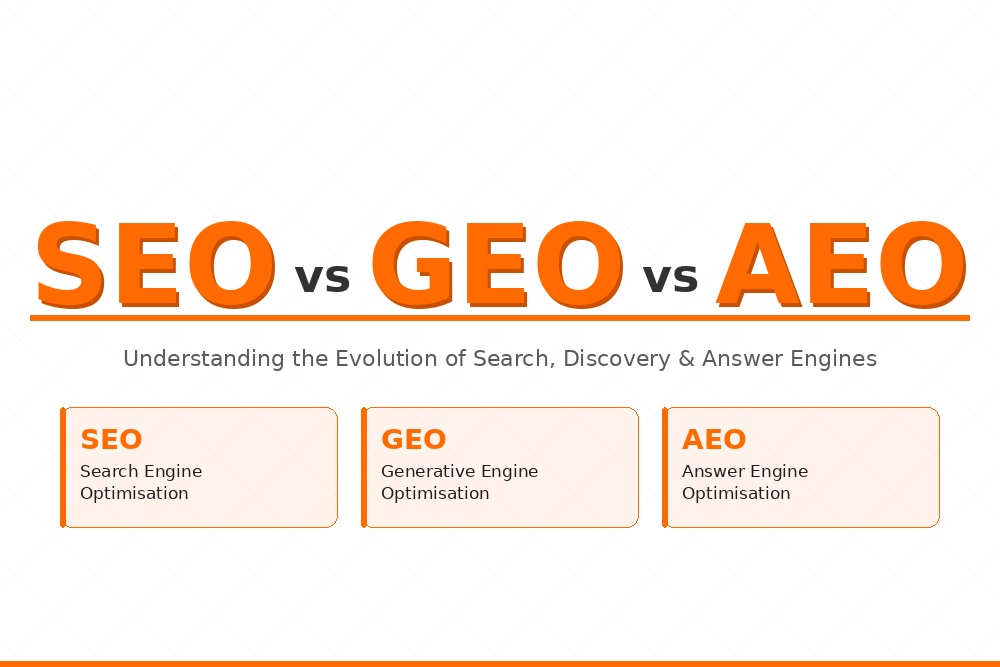

AEO vs SEO vs GEO
SEO (Search Engine Optimisation), AEO (Answer Engine Optimisation), and GEO (Generative Engine Optimisation) are three distinct approaches to search visibility, each targeting a different engine. SEO focuses on ranking your content in Google's search results. AEO focuses on being selected as the direct answer in featured snippets, AI Overviews, and voice search. GEO focuses on being cited by large language models (ChatGPT, Perplexity, Gemini, and Claude) when they generate responses to user queries. In 2026, all three matter. Optimising for only one means being invisible to the other two.
The Problem: Most Content Teams Are Still Playing a 2019 Game
Let's say the quiet part out loud. Most B2B content teams still operate with one metric: Google rankings. Write a post, target the keyword, earn a few backlinks, watch traffic climb.
That model isn't broken. It's just no longer complete.
Here's what's changed:
• AI Overviews now appear above organic results. Your page can rank #1 and still get bypassed because Google's AI answers the question before the user sees your link.
• Buyers research in ChatGPT and Perplexity before they Google. For research-level B2B questions, AI assistants are increasingly the starting point, not search engines.
• Voice search gives one answer. Not ten results. Either your content is extracted as that answer, or someone else's is.
Across our portfolio of B2B SaaS and AI-first companies, we're watching the same pattern: companies that optimised purely for Google traffic are seeing click-through rates drop even as rankings hold. The ones growing fastest have restructured their content to be found three different ways. Not three separate content strategies. One strategy, built to satisfy three engines simultaneously. This is what we cover in detail in our Content Marketing approach.
"In 2026, visibility is no longer about ranking pages. It's about being selected, extracted, and cited. Traffic is now a byproduct. Trust is the new distribution channel."
-Mathi Ganesh, Founder & CMO, GTMVerse
What Is SEO: And Why It Has Changed More Than People Admit
SEO (Search Engine Optimisation) is the practice of structuring, writing, and building authority around your content so it ranks higher in search engine results pages. It works through three primary levers: on-page signals (keywords, structure, intent match), technical health (speed, crawlability, schema), and off-page authority (backlinks, topical trust). SEO gets your content discovered by people actively searching for what you offer.
Google now processes queries differently. Its AI systems evaluate content for intent match and depth of coverage, not just keyword density and domain authority. And with AI Overviews appearing above organic results for an increasing share of queries, ranking #1 no longer guarantees the same click volume it did three years ago.
The SEO teams winning right now aren't doing more. They're optimising more specifically: for search intent, for topical authority, and increasingly for the structural features that feed into AI extraction. Which is exactly what our SEO services are built around.
Takeaway: SEO gets you into the game. It's the foundation the other two layers are built on. A page that doesn't rank is unlikely to be extracted or cited at scale.
.png)
What Is AEO (Answer Engine Optimisation): A Structural Problem, Not a Content Problem
AEO (Answer Engine Optimisation) is the practice of structuring content so it can be directly extracted and served as a precise answer by AI systems, search engines, and voice assistants, without requiring the user to click through to the full page. AEO works through structural signals: direct answer paragraphs, FAQ sections with complete standalone answers, question-format headers, and definition boxes that AI systems can lift verbatim. We cover that in detail here: Zero-Click Content: Stop Chasing Clicks, Start Owning Influence.
The difference between ranking and being extracted is almost entirely structural. Two posts can rank equally well for the same keyword. The one that answers the question directly, concisely, and within the first 300 words is the one that gets extracted.
The core AEO requirements are not complicated. Most content teams just haven't made them standard practice:
• Direct answer paragraph within the first 300 words: 50 to 80 words. Complete answer. No cliffhangers. Structured as: "[Topic] is [definition]. Specifically, [expansion with context]."
• FAQ section at the end of every post: 4 to 8 questions, 40 to 60 word answers each. Complete enough to be extracted. Concise enough to be quoted.
• Question-format H2s and H3s: Not "Benefits of X" but "What are the benefits of X?" because that is how people actually search.
• Definition boxes for any concept that could be misunderstood: clean, standalone definitions that AI extraction systems can pull verbatim.
Real example from our work: When we rebuilt Zoca's content architecture, shifting from essay-style posts to structured, question-led formats with proper answer paragraphs. Their featured snippet appearances increased by 87% within 60 days. Same domain. Same keywords. Just a structural change in how the content was built.
.png)
AEO vs GEO: What's the Difference? (And Why It Matters)
This is the question most marketers haven't thought through yet. AEO and GEO sound similar. Both are about being the answer. But they target different systems with different signals.
The short version: AEO is about being extracted from what you've written. GEO is about being trusted enough that an AI cites you when generating something new.
They're not competing. A post built for AEO extraction also tends to signal the structural authority that supports GEO citation. But the content signals that drive GEO are fundamentally about originality. That is where most teams fall short.
What Is GEO (Generative Engine Optimisation): The Opportunity Most Teams Are Missing
GEO (Generative Engine Optimisation) is the practice of building content authority signals so that large language models (ChatGPT, Perplexity, Gemini, Claude) cite your content when generating responses to user queries. Unlike SEO (which targets ranking algorithms) or AEO (which targets extraction systems), GEO targets the training data patterns and live retrieval systems that LLMs use to decide which sources are worth citing. It is won through originality: first-party data, named frameworks, expert attribution, and comprehensive coverage that no other source provides.
This is the newest of the three, and the least understood. It's also where the biggest competitive advantage exists right now. Most teams haven't started.
The GTMVerse Content Compounding Model
Layer 1: SEO drives Discovery. Your content gets found on Google. The foundation. Without this, layers 2 and 3 are limited in reach.
Layer 2: AEO drives Extraction. Your content gets selected as the direct answer in featured snippets, AI Overviews, and voice results.
Layer 3: GEO drives Citation. Your content gets cited by LLMs (ChatGPT, Perplexity, Gemini, Claude) when users ask research-level questions.
One post. Three distribution channels. Compounding reach without compounding effort.
GEO Signal 1: Proprietary Data and First-Party Research
AI models cite sources that contain information unavailable elsewhere. Generic summaries of existing research don't get cited. They get absorbed and restated without attribution. Original client data, proprietary benchmarks, and first-hand case studies do get cited.
What this looks like in practice: Instead of citing "studies show that content marketing generates 3x more leads," GTMVerse cites specific client results: "Zoca achieved a 10x increase in demo volume through a content-led GTM system built from scratch." That specificity is what makes AI models treat a source as authoritative rather than generic.
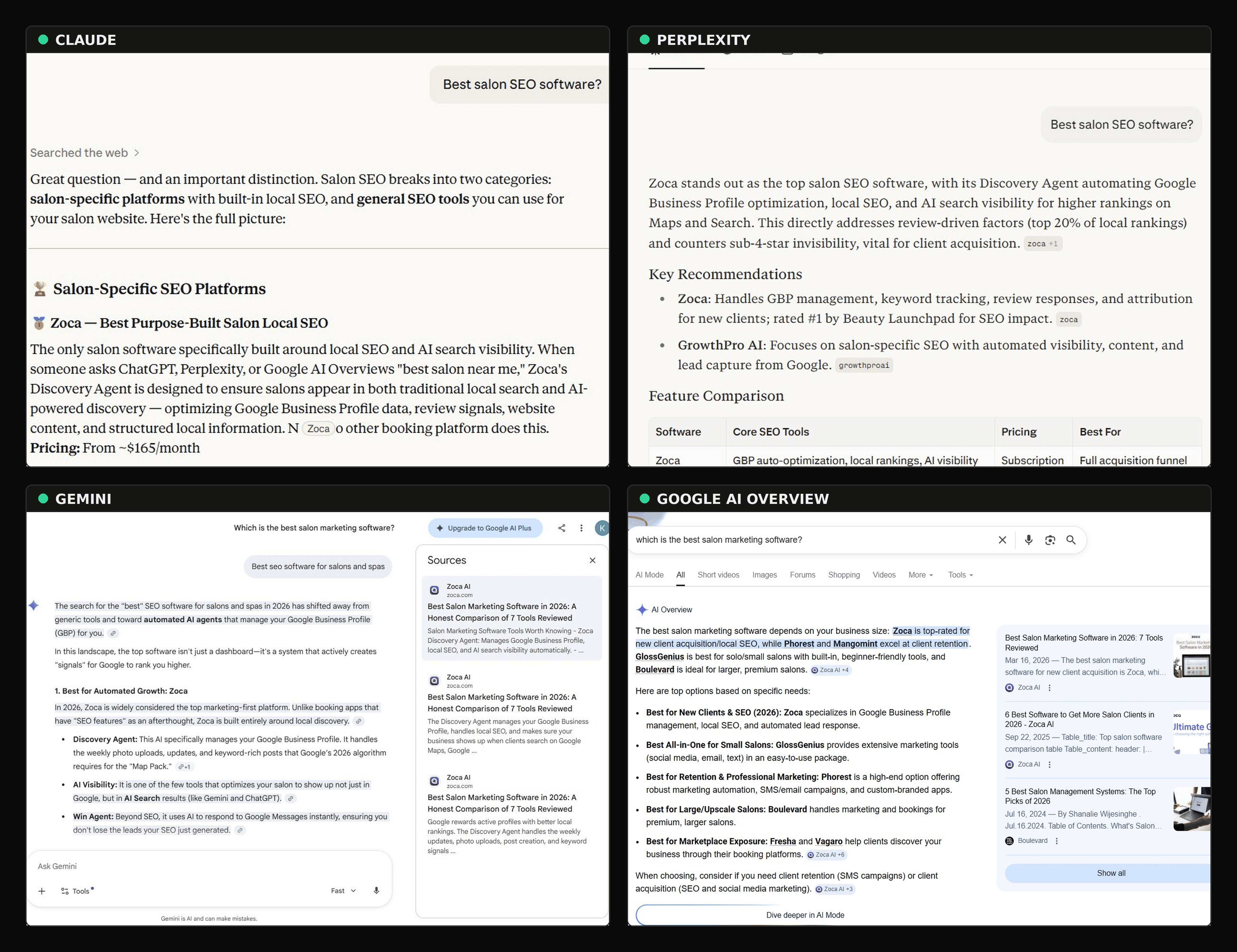
This is exactly what GEO looks like in practice. Zoca, one of our clients, now appears in AI-generated responses across Perplexity and Claude when users search for "best salon marketing software" and related queries. This didn't happen by accident. It's the direct result of building content with first-party proof, specific outcome numbers, and authoritative positioning that AI models can cite with confidence. The GTM system we built for Zoca, from 0 to 1 all the way to multi-million ARR, is the kind of operator-grade evidence that earns citations.
GEO Signal 2: Named Frameworks
If you describe a process without naming it, AI models absorb the idea and restate it in their own terms, without attributing it to you. If you name it ("The GTMVerse Content Compounding Model") it becomes a citable artifact.
This is one of the highest-ROI changes a content team can make. Every framework you introduce, every model you define, every methodology you articulate: give it a name. Named things get cited. Unnamed things get paraphrased.
GEO Signal 3: Specific Statistics With Context
Not just the number. What it means and where it came from.
Less citable vs More citable
Less citable: "Featured snippet appearances nearly doubled after structural changes."
More citable: "Zoca's featured snippet appearances increased by 87% in 60 days after restructuring 12 posts to include direct answer paragraphs and FAQ sections, with no change to keyword targeting or link building."
The second version is specific, attributed, reproducible, and contextual. That's what AI models want to quote.
GEO Signal 4: Expert Attribution
Quotes from named individuals with clear credentials signal to AI models that this content represents a specific, authoritative perspective. "The GTMVerse team believes..." is weaker than "According to Mathi Ganesh, Founder and CMO of GTMVerse, who has scaled 20+ products across B2B SaaS..." This is also where positioning clarity matters: a brand with a well-defined point of view earns citations. A generic brand doesn't. This is what our Product Marketing services build: positioning that's sharp enough to be cited, not just read.
This is also E-E-A-T applied to GEO. Google's quality signals and LLM citation signals increasingly overlap. For a deeper breakdown of how E-E-A-T affects rankings, see our post: What Is Google E-E-A-T and How Does It Affect Your SEO?.
GEO Signal 5: Comprehensive Coverage of Adjacent Questions
AI models prefer one thorough source over ten partial ones. A post that covers the primary question and the semantic neighbour questions: "what is AEO," "how does AEO differ from SEO," "is GEO replacing SEO," "how to measure GEO" becomes a natural hub for citation. A post that answers only the headline question gets used once, if at all.
.png)
When to Focus on SEO vs AEO vs GEO
Not every piece of content needs equal investment across all three. Here's how to prioritise based on what your content is trying to do and where your buyer is in their journey.
In Short:
SEO = use when you need to be discovered for a keyword or topic
AEO = use when you need to be the answer, not just a result
GEO = use when you need to exist in AI-generated responses
Best practice: every post is built for all three. The investment weighting shifts based on stage and intent. The structure stays consistent.
Is GEO Replacing SEO? The Honest Answer
No. And anyone telling you otherwise is selling something.
GEO does not replace SEO. It builds on top of it. A page that doesn't rank is unlikely to be extracted (AEO) or widely cited (GEO). Strong SEO creates the discoverability and authority that makes AEO and GEO work better.
What IS changing is the relative weight of these channels. Three years ago, 95% of organic discovery happened through Google search results. In 2026, a growing share (particularly for research-level B2B queries) starts with AI assistants. Optimising only for Google means you're present for one part of the buyer journey and invisible for another.
"The question isn't 'is SEO dead?' The question is: when your buyer types a research question into ChatGPT at 10pm, does your company exist in that answer? For most B2B companies right now, the answer is no."
SEO vs AEO vs GEO: The Full 8-Dimension Comparison
How to Optimise for AI Search in 2026: A Practical Action Plan
This isn't a complete overhaul. It's a series of specific, high-leverage changes that most teams can execute within four weeks. We've run this across clients in B2B SaaS and AI-first companies and the results are consistent. This is the exact audit we run for every new GTMVerse client in the first 30 days.
Week 1 to 2: Fix Your Top 10 Posts for AEO
• Pull your 10 highest-traffic posts from Google Search Console.
• Check each one: does it answer its primary keyword directly within the first 300 words? If not, add an answer paragraph at the top. 50 to 80 words. Complete answer. No cliffhangers.
• Add or rebuild the FAQ section: 4 to 6 questions, 40 to 60 word answers each. Make sure answers are complete and standalone.
• Update your H2s to question format where it fits naturally: "Benefits of content marketing" becomes "What are the benefits of content marketing for B2B SaaS?"
• Add a definition box for any jargon-heavy concept in the post.
Month 1 to 2: Build GEO Signals Into Every New Post
• Every post needs at least one first-party data point: something from your own client work, analysis, or experience that doesn't exist anywhere else.
• Name your frameworks: any process you describe, give it a name. "The [Company] [Process] Model." Named things get cited. Unnamed things get absorbed.
• Attribute every insight to a named human. Not "the team." A person with a real role and genuine expertise.
• Cover the adjacent questions. Use Google's People Also Ask and Perplexity's follow-up questions as your guide. Be the comprehensive source, not the partial one.
Month 2 to 3: Build the Measurement Layer
Set up AI citation tracking. Tools like Profound and Otterly track your brand and content mentions across AI responses. Start measuring before you optimise further. If you need a clean attribution model for content-influenced pipeline, our RevOps services are built specifically to connect content to revenue visibility.
• Monitor featured snippet appearances in Search Console. Track which posts earned snippets after AEO changes and which didn't.
• Audit new posts for all three engines before publishing. Run a simple 3-question checklist: Does this rank on SEO? Is it extractable for AEO? Does it contain original signals for GEO?
The 3-Engine Content Checklist: Add This to Every Brief
SEO: Is the primary keyword in H1, first 100 words, at least one H2, and the meta description?
AEO: Is there a direct answer paragraph in the first 300 words? Is there a FAQ section with 40 to 60 word answers?
GEO: Does the post contain at least one first-party data point? Is any new framework named? Is there expert attribution with named credentials?
What's Changing in 2026: What We're Seeing Across B2B Companies
We work with 12+ B2B SaaS and AI-first companies across different growth stages. Here's what the data is showing:
• AI-first buyers research differently. Particularly in the 28 to 40 founder/operator demographic, ChatGPT and Perplexity are the first stop for research-level questions, not Google. Content that doesn't exist in those channels is invisible to a meaningful segment of the ICP.
• Click-through rates are declining on informational queries. Google's AI Overviews are absorbing a growing share of clicks that used to go to ranked pages. Posts optimised only for ranking, not for extraction, are seeing CTR drop without any change in rankings.
• Content with named frameworks earns citations naturally. Across the content we've built with unique framework names and first-party data, we're seeing organic AI citations appearing in Perplexity responses within 60 to 90 days of publication.
• AEO wins compound with SEO authority. Pages that earn featured snippets also tend to see improved rankings over time. Google appears to treat extraction-worthiness as a quality signal.
The Tools and Engines You're Optimising For
For completeness (semantic relevance matters), here are the specific platforms your content needs to be visible within:
Key Takeaways
• SEO, AEO, and GEO are three distinct engines, each requiring different content signals. Optimising for only one means being invisible to the other two.
• SEO gets you into the game. AEO makes you the answer. GEO gets you cited by the AI tools your buyers use for research.
• AEO is a structural problem, not a content quality problem. Direct answer paragraphs, FAQ sections, and question-format headers are the primary levers.
• GEO is won through originality. Named frameworks, first-party data, and expert attribution are what AI models cite. Generic content gets absorbed without attribution.
• GEO is not replacing SEO. It layers on top of it. Strong SEO creates the authority and discoverability that GEO builds on.
• The teams winning in 2026 aren't creating more content. They're building content that's architecturally designed to be found three different ways from a single post.
• Measurement is evolving. Tools like Profound and Otterly track AI citation. Start monitoring now, before optimising further.
The GTMVerse POV
The companies that will own organic demand through 2027 and beyond are not the ones publishing the most content. They're the ones that understand content as an information architecture problem, not a publishing problem. SEO, AEO, and GEO are not three channels to manage separately. They're three lenses through which a single, well-owned content system delivers compounding returns. The GTMVerse Content Compounding Model (Discovery, Extraction, Citation) is the framework we use to build content that doesn't just rank, but compounds. Most teams pick one lens and optimise for it. The operators building category authority are using all three from day one.
The Search Game Has Three Engines Now. Are You Playing All Three?
SEO gets you on the page. AEO makes you the answer. GEO gets you cited by the AI tools your buyers trust before they ever run a search.
Most B2B companies are winning one of these. The ones building category authority in 2026 are winning all three from a single, well-built content system.
That's exactly what GTMVerse builds.
Book a Free Growth Audit to see where you stand across all three engines.
.png)
Frequently Asked Questions About AEO vs SEO vs GEO
What is the difference between SEO, AEO, and GEO?
SEO optimises content to rank in search engine results pages. AEO optimises content to be extracted and surfaced as the direct answer in featured snippets, AI Overviews, and voice search. GEO optimises content to be cited by large language models (ChatGPT, Perplexity, Gemini) when they generate responses. All three are required for full search visibility in 2026.
Is GEO replacing SEO?
No. GEO layers on top of SEO and does not replace it. A page that doesn't rank is unlikely to be widely extracted (AEO) or frequently cited (GEO). Strong SEO creates the authority and discoverability that makes the other two work. What's changing is that Google ranking alone is no longer sufficient for complete organic visibility.
How do I optimise for AEO?
Add a direct answer paragraph within the first 300 words of every post (50 to 80 words, complete answer, no cliffhangers). Build a FAQ section at the end with 40 to 60 word answers per question. Update headers to question format where natural. Add definition boxes for key concepts. These structural changes alone typically improve featured snippet appearances within 4 to 8 weeks.
What content performs best for GEO?
Original research with specific numbers, case studies with named clients and real outcomes, posts that introduce uniquely named frameworks, and content with clear expert attribution. AI models cite sources containing information unavailable elsewhere. Generic summaries of existing knowledge get absorbed and restated without attribution. First-party data and named frameworks get cited directly.
AEO vs GEO: what's the actual difference?
AEO targets Google's extraction systems (featured snippets, AI Overviews, voice search) and is won through structural signals like answer placement and FAQ format. GEO targets large language models like ChatGPT and Perplexity and is won through originality signals: proprietary data, named frameworks, and expert attribution. A post can be built to satisfy both simultaneously.
How do I measure GEO performance?
Tools like Profound and Otterly track brand and content citation across AI responses. A practical starting point: manually search your primary topics in ChatGPT and Perplexity and note whether your content or brand appears. Track this monthly. As AI citation tracking matures, this will become a standard part of organic performance reporting.
How long does it take to see results from AEO changes?
Structural AEO changes (adding answer paragraphs and FAQ sections to existing posts) typically produce measurable results within 4 to 8 weeks. Google re-evaluates content frequently, and well-structured answer content often earns featured snippet placement faster than equivalent SEO campaigns targeting the same keyword.
Can I optimise one piece of content for all three engines?
Yes. That is the entire point of the GTMVerse Content Compounding Model. A post built with direct answer paragraphs (AEO), strong keyword structure and internal linking (SEO), and original data with a named framework (GEO) simultaneously satisfies all three engines. One post. Three distribution channels. The structure is the strategy.
FAQs
GTMVerse works best with companies where scale introduces fragmentation, not simplicity.



Growth shouldn’t feel uncertain
When Go-To-Market has an owner, clarity replaces chaos, and momentum compounds. Let us own your Go-To-Market, end to end.