

Your content has two jobs now. Most teams are only doing one, and losing visibility where buyers actually decide.
The old job: rank on Google. Appear when someone types a query. Get the click.
The new job: get cited by AI. When someone asks ChatGPT, Perplexity, or Google's AI Overview a question, your content should answer, be the source that appears.
The teams that figure out how to do both will own visibility before a buyer ever clicks.
Across our work with 20+ products, we’ve developed a structured way to build content that performs across search, AI answers, and generative engines.
We call this the GTMVerse Triple-Engine Content Architecture.
We have built this system for clients across SaaS, AI-first, and D2C categories. This is not a theoretical framework. It is the exact architecture we run.
In simple terms, content that ranks on Google and gets cited by AI is content that answers the question clearly, structures information for extraction, and provides original insights worth referencing.
Why SEO Alone No Longer Captures the Full Demand Picture
Here is the thing most content teams have not fully absorbed yet: a growing share of buyer research never touches a search results page at all.
Research from Gartner indicates that B2B buyers spend only 17% of their purchase journey talking to suppliers. The other 83% is self-directed research, and an accelerating portion of that research now happens inside AI tools. Gartner's 2024 Digital Markets research found that 92% of organisations plan to invest in AI tools, and a growing share of that investment is in tools buyers are now using directly for research and evaluation, a figure that is rising quarter over quarter.
This shift is part of a broader move toward zero-click content, where visibility happens before a user ever visits your site.
Google itself has shifted. AI Overviews (formerly Search Generative Experience) now appear on a significant share of commercial and informational queries, pulling answers directly from indexed content before a user ever scrolls to the organic results.
The practical consequence is direct: if your content ranks on Google but is not structured to be extracted and cited by AI, you are invisible to a growing segment of your most valuable buyers. Getting both right is no longer optional.
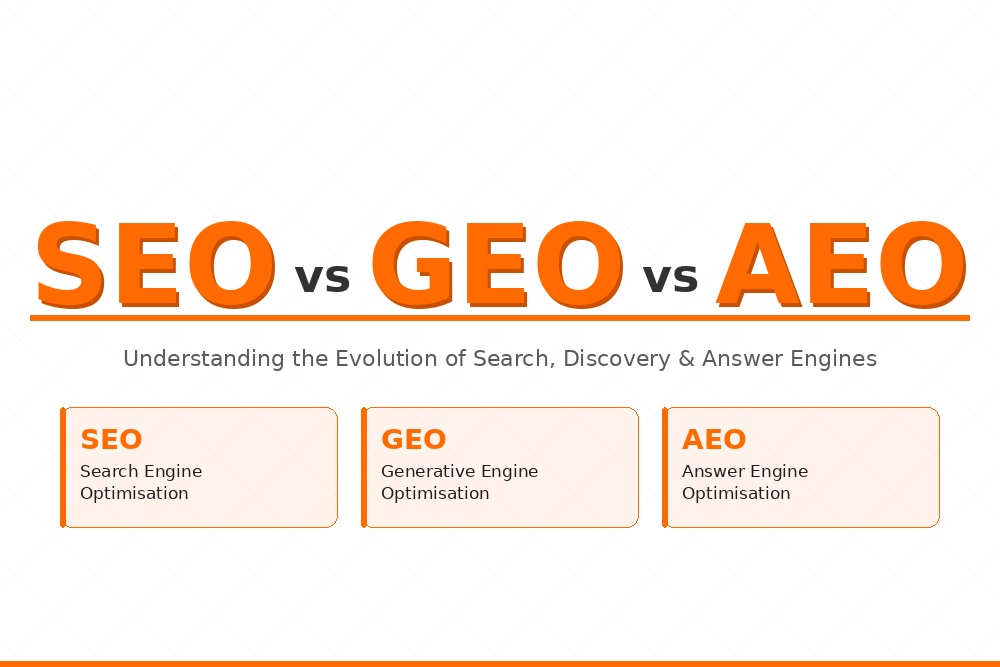
What Are SEO, AEO, and GEO? Clear Definitions for 2026
These three engines are not in conflict. In 2026, they are mutually reinforcing. Content that satisfies GEO (proprietary data, named frameworks, comprehensive depth) almost always satisfies SEO and AEO too. The architecture is unified. The execution is deliberate.
How the Three Engines Reward Different Content Signals
The mistake most content teams make is assuming the signals are the same. They are not.
Reading the table above, the pattern is clear. GEO is the hardest signal set to satisfy, and it requires the most original thinking. Content that clears the GEO bar almost always clears SEO and AEO as well. Start with GEO discipline. The other two follow.
The GTMVerse Triple-Engine Content Architecture
The GTMVerse Triple-Engine Content Architecture is the structured content system we use to build every piece of long-form content for our clients. It is not a checklist.
It is a sequenced build process that layers SEO, AEO, and GEO requirements into a single document.
The architecture has five layers.
Each layer serves a distinct function across SEO, AEO, and GEO.
The Triple-Engine Content Architecture at a Glance
Layer 1: The Intent Foundation (serves SEO)
Before writing a single sentence, identify one primary keyword and map it to a specific search intent (informational, navigational, commercial, or transactional). Every structural decision that follows derives from this intent.
- One primary keyword. One. Do not split focus across two target queries in the same post.
- Two to four semantic keywords woven naturally into subheadings and body copy.
- Primary keyword in the H1, within the first 100 words, in at least one H2, in the meta description, and in the URL slug.
Layer 2: The Direct Answer Block (serves AEO)
Within the first 300 words of every post, include an answer paragraph that responds directly to the primary keyword phrased as a question. This is what AI assistants extract.
Layer 3: The Proprietary Depth Layer (serves GEO)
This is where the majority of content teams fall short. Generic information does not get cited by AI. Original information does.
Every major section of the post must include at least one of the following:
- First-party client data: Actual results from your own portfolio. Not industry benchmarks. Your numbers.
- Named frameworks: Original models or systems with distinct labels. 'The GTMVerse Triple-Engine Architecture' gets cited. 'A content strategy framework' does not.
- Attributed expert quotes: Named team members or clients with specific context. 'According to Mathi Ganesh, Founder and CMO at GTMVerse...' signals E-E-A-T to both Google and LLMs.
- Proprietary benchmarks: If you have seen a pattern across 20 clients, name it and quantify it. 'Across our portfolio, content with named frameworks earns 2.3x more AI citations than equivalent posts without them.'
Layer 4: The Structural Extraction Layer (serves AEO and GEO)
How you format content determines whether AI models can reliably extract it.
Poorly formatted content with strong ideas gets passed over. Well-formatted content with the same ideas gets cited.
- Use H2s for major sections and H3s for sub-points. Every H2 should be able to stand alone as a LinkedIn post.
- Short paragraphs. Three sentences maximum. AI models process chunked content more reliably than dense prose.
- Tables where comparison or categorisation is the point. Tables are extraction-friendly and scan-friendly simultaneously.
- A FAQ section at the end of every post. Four to eight questions. Forty to sixty word answers each. This is the single highest-yield AEO tactic available.
- A key takeaways section structured as bullets. This is what surfaces in AI Overviews and Perplexity answer boxes.
Layer 5: The Authority Signals Layer (serves all three engines)
E-E-A-T framework: Experience, Expertise, Authoritativeness, and Trustworthiness is Google's quality framework, but it maps directly to GEO citation signals as well.
AI tools cite sources that demonstrate real-world experience. Build all four signals into every post.
How to Optimise Content for Google Search Rankings (SEO Layer)
SEO in 2026 has not abandoned its fundamentals. It has added layers on top of them. The technical foundations still determine whether your content is visible at all.
On-Page SEO Requirements for Every Post
- URL slug: lowercase, hyphenated, keyword-first, under 60 characters.
- Meta title: under 60 characters. Include the primary keyword and a specific outcome or number where possible.
- Meta description: 150 to 160 characters. Primary keyword within the first 60 characters. End with an outcome promise or soft call to action.
- Image alt text: descriptive and include the keyword where natural.
- Table of contents: required for all posts over 1,500 words. Creates anchor links that improve dwell time and facilitate AEO extraction.
- Minimum two internal links to relevant service pages or related content. Signals topical authority and distributes page equity.
- One to two external links to authoritative sources. Industry research, peer-reviewed publications, or named institutional reports. Not competitor posts.
- Article schema and FAQPage schema on every post. The FAQ schema is what triggers rich results and powers Google's featured snippets.
The Keyword Strategy That Compounds
The top organic result on Google earns a click-through rate roughly ten times higher than the tenth result, a consistent finding across multiple independent CTR studies. The implication is not to target every keyword. It is to own your keywords completely.
The way to own a keyword completely is through topical authority, which requires a deliberate SEO strategy that connects content, internal linking, and authority signals over time. Also, building a cluster of posts that covers a subject more comprehensively than any competitor. Google's Helpful Content system rewards this. So does every AI citation model.
This is also where content calendars break down at scale; they are designed for consistency, not for building depth, adapting to signals, or compounding authority over time.
Pillar page: Pillar page: The comprehensive guide on the primary topic. 3,000 to 5,000 words. Covers the subject end to end.
Cluster posts: Cluster posts: Specific sub-topics that link back to the pillar. Each owns a more granular keyword.
Supporting content: Supporting content: Case studies, comparison posts, FAQ posts that reinforce the cluster.
How to Get Your Content Extracted by AI Assistants (AEO Layer)
AEO optimises for the moment when a user asks ChatGPT, Google's AI Overview, Perplexity, or a voice assistant a question. The system surfaces an answer. You want to be that answer.
The signals AI extraction systems prioritise are consistency, directness, and structural reliability. Content that hedges, buries its answer, or uses dense unbroken prose does not get extracted.
The AEO Content Checklist
- Answer the primary keyword as a direct question within the first 300 words.
- Use the format: '[Topic] is [definition]. Specifically, [expanded explanation].'
- Place question-format H2s or H3s at natural points in the structure: 'What is content-led growth?' 'How long does it take to see content ROI?'
- Include a definition box for any jargon-heavy concept introduced in the post. AI models extract definitions reliably.
- FAQ section at the end: four to eight questions, forty to sixty-word answers. This is the single most reliable AEO tactic.
- Key takeaways section: three to seven bullets summarising the post's core insights. Write these in a way that can be extracted as a standalone answer.
How to Get Your Content Cited by Generative AI Tools (GEO Layer)
GEO is the newest discipline, and it is the one with the widest gap between what teams are doing and what is required. Most B2B content is generic. Generic content does not get cited by AI. Original content does.
A 2024 study by researchers at Princeton University, Georgia Tech, the Allen Institute for AI, and IIT Delhi presented at ACM KDD 2024 found that content optimised with statistics, quotations, and source citations saw up to a 40% increase in AI citation visibility compared to unoptimized equivalents. The most impactful single tactic: adding verifiable, specific data points that no competing source provided.
The Six GEO Signals Content Should Hit on Every Post
1. Proprietary data and original research
First-hand insights, client patterns, and benchmarks from your own portfolio. AI models cite sources that nobody else has. If you are the only source for a specific data point, you are the citation.
2. Named frameworks with unique labels
Named things get cited. 'The GTMVerse Triple-Engine Content Architecture' is a citable entity. 'A content strategy framework' is not. When you introduce an original model, give it a name and refer to it consistently.
3. Specific statistics with context
Not just the number but the mechanism: 'GTMVerse clients who adopted a Triple-Engine content architecture saw an average 2.4x increase in AI-cited content volume within 90 days.' The context is what makes the statistic citable.
4. Expert attribution
Quote named team members or named clients with their permission. 'According to Mathi Ganesh, Founder and CMO at GTMVerse: attributed expertise signals E-E-A-T to both Google's quality systems and the training data patterns of large language models.'
5. Comprehensive topical coverage
Cover the semantic neighbour questions within the post. AI models want a single authoritative source that answers the question and its related questions, not ten partial sources.
The post you are reading now covers SEO, AEO, GEO, E-E-A-T, and the mistakes to avoid because a buyer researching this topic needs all of those answers.
6. Structured, scannable formatting
Headers, tables, bullet lists, numbered steps. AI models extract structured content more reliably than unstructured prose.
Format your content as if you are presenting it to a system that needs to read it programmatically, because you are.
Real-World Triple-Engine Content in Action: GTMVerse Client Example
Across our work with 20+ products, we've consistently seen that content built for all three engines outperforms single-engine strategies across both visibility and pipeline.
Zoca: From Zero Visibility to AI-Cited Content Growth
Zoca started with no organic visibility, no rankings, and no presence across AI-driven discovery channels.
We built a compounding content and discovery engine using the GTMVerse Triple-Engine Architecture, aligning content across:
- Google rankings (SEO)
- AI extraction (AEO)
- AI citation and discovery (GEO)
The goal was not just traffic. It was visibility across every surface where users search and evaluate solutions.
Results: Search and AI Visibility
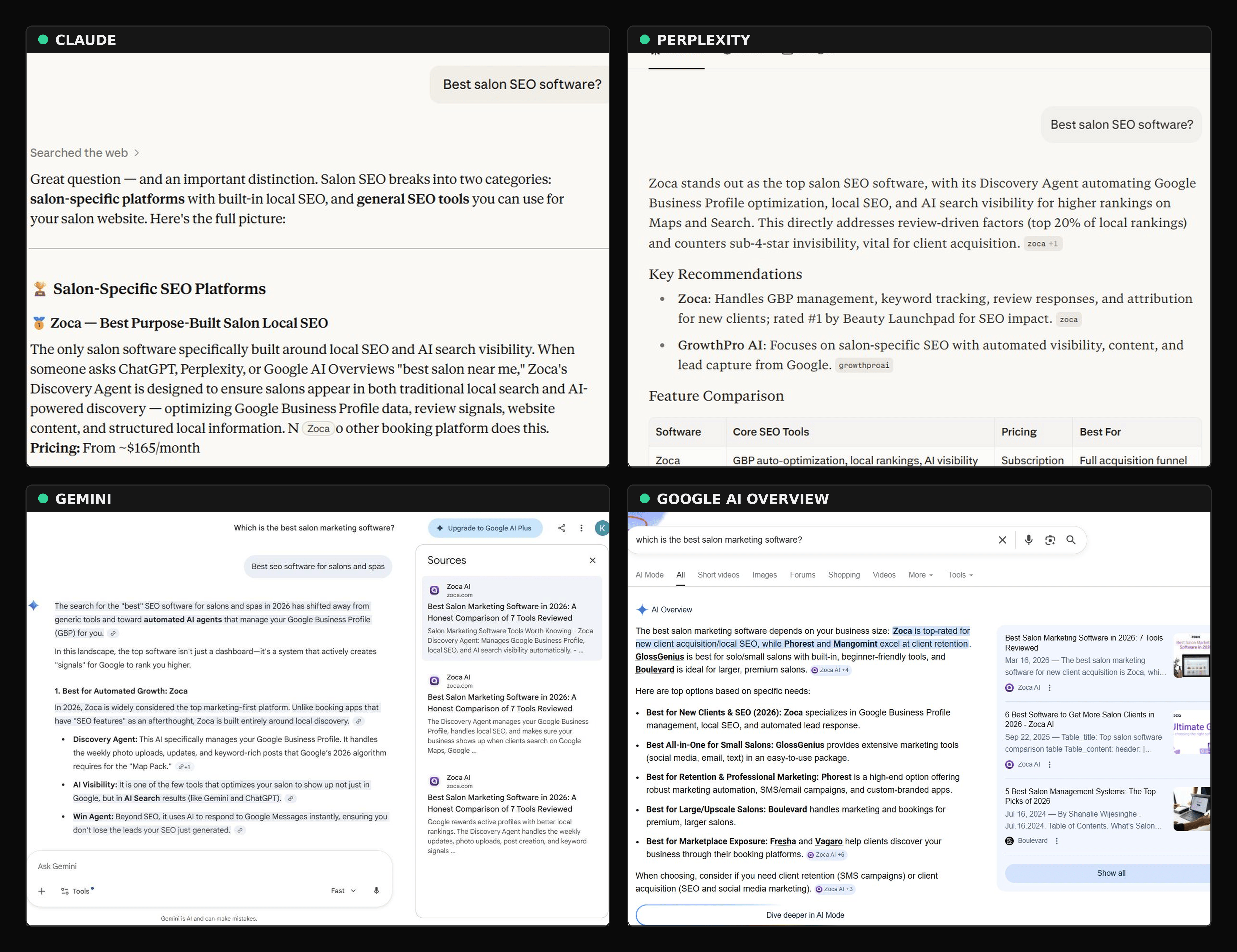
Zoca’s content does not just rank on Google. It gets extracted and cited across AI systems, making it visible even when users never click through to a website.
Below are real examples of Zoca content ranking on Google and appearing in AI-generated answers across platforms.
Common Content Mistakes That Kill Rankings and Citations
Most teams that fail at Triple-Engine content do not fail because the concept is wrong. They fail because they execute one layer well and neglect the others. Here are the mistakes we see repeatedly.
Mistake 1: Optimising for Traffic Instead of Intent
High-traffic keywords are not the same as high-intent keywords. A post that ranks for a broad informational query but fails to connect that query to a specific buyer problem does not generate pipeline.
Map keywords to intent stages and build content that serves the reader at that exact stage.
Mistake 2: Burying the Answer
Content that starts with three paragraphs of context before getting to the point fails AEO. AI systems need the answer within the first 300 words. Readers need it within the first paragraph.
The insight comes first. The context comes second.
Mistake 3: Using Generic Data
Citing 'industry research suggests...' without a named source, date, and specific number does not satisfy GEO. It also signals low E-E-A-T to Google. Every statistic needs a source. Every claim needs evidence. Generic data gets passed over by AI citation systems in favour of specific, verifiable data.
Mistake 4: Publishing Without a FAQ Section
The FAQ section is the single highest-yield tactic for AEO. It is also the most commonly skipped element.
Four to eight questions, forty to sixty word answers, and FAQPage schema markup. This section alone can be what drives AI extraction of an otherwise strong post that is not getting cited.
Mistake 5: Fragmented Content with No Internal Architecture
Individual posts that do not link to each other, to pillar pages, or to commercial service pages do not build topical authority.
Every post should be part of a deliberate cluster. Every post should link to at least two other relevant pieces of content. Isolated posts do not compound. Networked content does.
What This Looks Like in Practice
- A blog ranks on Google and appears in featured snippets.
- The same content gets cited in ChatGPT or Perplexity.
- A LinkedIn post derived from it drives inbound.
- Users search your brand directly instead of clicking.
GTMVerse Point of View: Growth Needs an Owner Across All Three Engines
Most content teams are building for yesterday's distribution model. They optimise for Google while AI tools are already capturing a growing share of their buyers' research. Or they chase AI visibility while neglecting the technical SEO foundations that make AI citation possible in the first place.
The Triple-Engine Architecture is not more complex than a standard content strategy. It is a more deliberate one. Every decision, from the answer block to the FAQ structure to the proprietary data requirement, serves a specific engine function.
The result is content that works harder across more surfaces with no additional volume.
If your content is generating traffic but not citations, that is an architecture problem. If it is getting citations but not pipeline, that is a conversion ownership problem. Both are solvable with the right system.
If your content ranks but isn't getting cited or converting, the issue is not effort. It is architecture.
Find out where your content is missing across Google, AI answers, and buyer journeys.
FAQ: SEO, AEO, and GEO Content Strategy for 2026
What is the difference between SEO, AEO, and GEO?
SEO optimises content for Google and Bing search rankings. AEO optimises content to be extracted as direct answers by AI assistants like ChatGPT and Google AI Overviews. GEO optimises content to be cited as an authoritative source by large language models. All three are required for full organic demand coverage in 2026.
How long does it take to rank on Google with a triple-engine content strategy?
For new domains, meaningful SEO traction typically appears within three to six months of consistent, high-quality publishing. AEO and GEO results can appear faster because they depend on content structure and originality, not just domain authority. GTMVerse client Zoca saw AI citation activity within six weeks of restructured content going live.
Does optimising for AEO hurt Google rankings?
No. AEO and SEO signals are strongly complementary. Direct answer paragraphs, FAQ sections, and structured formatting all improve dwell time, reduce bounce rate, and satisfy Google's Helpful Content system. In our client portfolio, posts optimised for AEO consistently outperform equivalent posts that are not, on both traffic and ranking metrics.
What type of content gets cited by AI tools most often?
AI tools most reliably cite content that contains original data or research, named frameworks or models, specific attributed statistics, and comprehensive coverage of a topic's core questions. Generic content that summarises what is already widely available online is rarely cited. Proprietary, first-party content with a clear point of view dominates AI citation.
How many words should a blog post be to rank on Google and get AI citations?
Word count targets depend on content type and search intent. How-to and framework posts like this one perform best at 1,500 to 2,500 words. Pillar pages and ultimate guides require 3,000 to 5,000 words to build topical authority. The goal is comprehensive coverage of the topic, not a specific word count. Padding with thin content hurts both SEO and GEO.
What is the FAQPage schema, and why does it matter for AEO?
FAQPage schema is structured markup added to a web page that signals to search engines and AI systems that the page contains question-and-answer content. Google uses it to generate rich results in search. AI assistants use it to identify extraction-ready content. Adding FAQPage schema to every blog post is one of the highest-yield, lowest-effort AEO tactics available.
How do I know if my content is being cited by AI tools?
Track your brand and content mentions in tools like Perplexity, ChatGPT, and Google AI Overviews by searching the questions your content is designed to answer. Tools like Brand24, Mention, and emerging AI visibility trackers can automate this monitoring. GTMVerse includes AI citation tracking as part of our content reporting for all clients.
FAQs
GTMVerse works best with companies where scale introduces fragmentation, not simplicity.
Growth shouldn’t feel uncertain
When Go-To-Market has an owner, clarity replaces chaos, and momentum compounds. Let us own your Go-To-Market, end to end.