


Gartner reported in March 2026 that 67% of B2B buyers prefer a rep-free experience, reinforcing how much of the buying journey now happens before a sales conversation begins.
A large part of that journey happens through organic search, comparison content, and independent research.
They optimize for traffic volume. They rank informational keywords that bring in researchers, not buyers. They celebrate 10,000 new monthly visitors while your demo calendar stays empty. The problem is not the channel. The problem is the strategy, and the agency executing it.
Traffic without a pipeline is a reporting illusion. We have built and run SEO systems for 20+ products across SaaS, AI-first, and D2C companies.
This list reflects how we evaluate SaaS SEO partners based on pipeline impact.
Quick Comparison of Top 7 B2B SaaS SEO Agencies
A quick operator view of where each agency typically fits best.
.png)
7 Best B2B SaaS SEO Agencies Ranked by Pipeline Impact (2026)
These agencies understand how SaaS actually gets bought, not just how pages get ranked.
We have included GTMVerse in this list because we operate in this category. The same 5-factor evaluation framework applies to us as to every other agency here.
1. GTMVerse: End-to-End GTM Ownership with Proven Pipeline Results
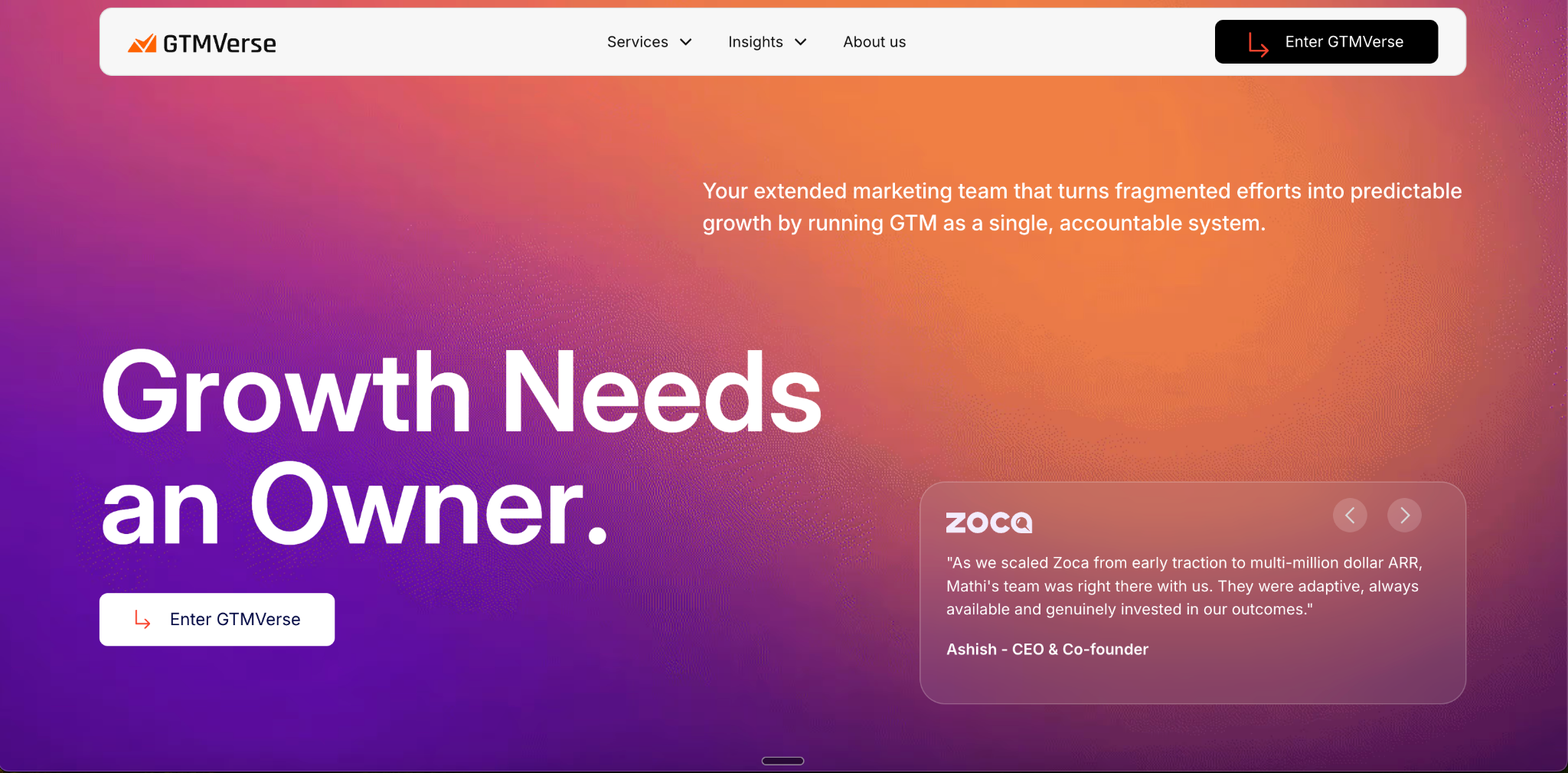
GTMVerse is not a traditional SEO agency. It is an operator-led GTM partner that treats search as one function within a unified growth system, not a standalone deliverable. Every engagement starts with ICP clarity and positioning before a single keyword is targeted or a single page is built.
Key Services
- ICP-driven keyword and content strategy
- BOFU SEO pages: comparisons, alternatives, integrations, pricing
- Technical SEO for crawl, indexing, and authority
- Conversion-focused SEO (turn rankings into demos)
- SEO-to-pipeline attribution and reporting
Supporting channels like paid and product marketing are used only where they improve SEO conversion outcomes.
Proof Points: Selected examples from internal GTMVerse engagements.
- Zomentum: conversion rate 0.5% to 2.3%, CPL reduced by 90%
- Snaptrude: 30x growth in organic clicks, 841,000 impressions in under four months
- Zoca: 10x increase in demo volume, 75% inbound-led growth
Pros
- Modular engagement model: scoped to your actual GTM gaps, not a fixed retainer
- Pipeline-linked reporting connects every deliverable to demo and revenue outcomes
- BOFU content mastery: comparisons, integrations, and pricing pages that convert
- 30-60-90 day rollout starts with BOFU capture and expands coverage from there
Cons
- Selective client intake: limited roster maintained to protect execution quality
- Best results require clear decision ownership on the client side from day one
Best For:
B2B SaaS teams that want SEO to directly drive demos and pipeline, not just traffic, with execution across content, technical SEO, and conversion.
2. Breaking B2B: Pipeline-First B2B SaaS SEO from Day One
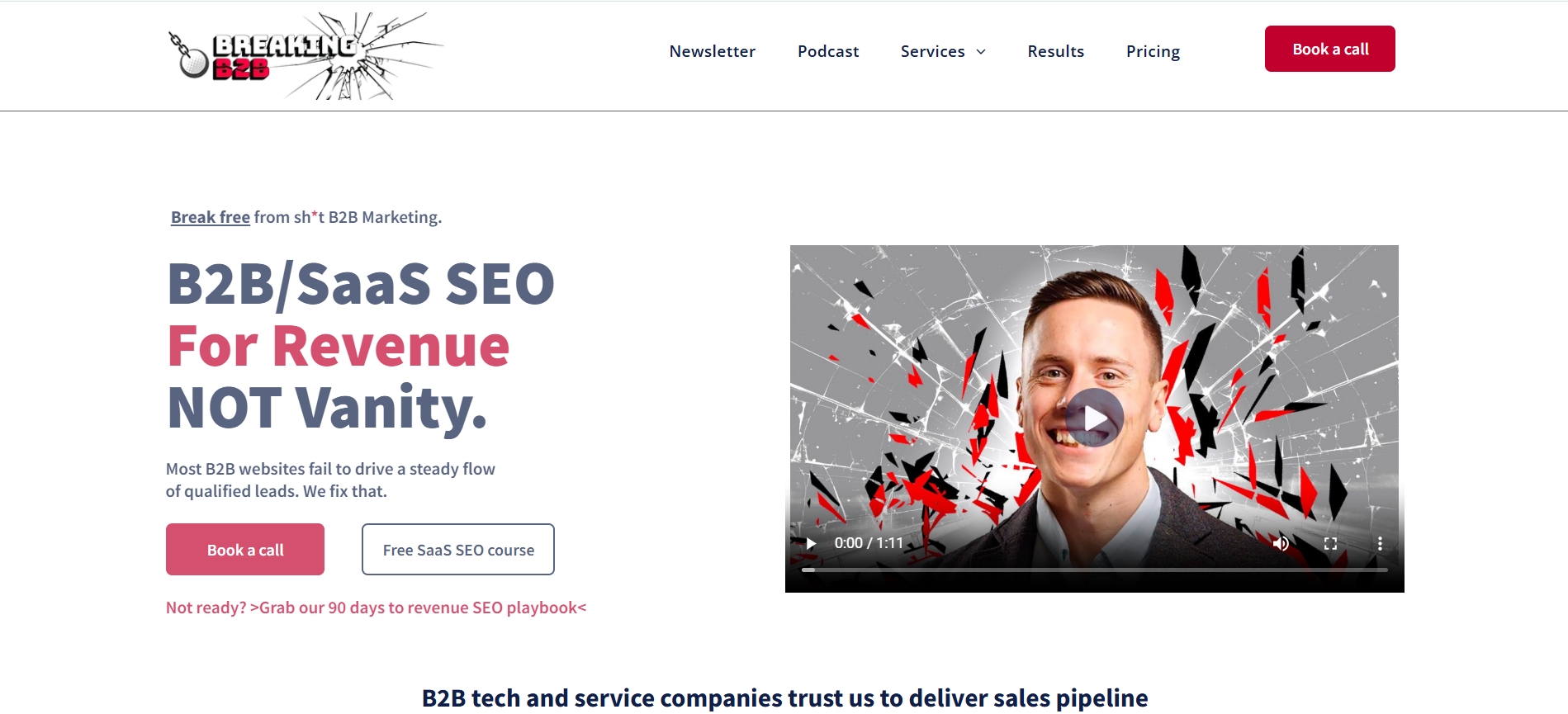
Breaking B2B is a specialist B2B SaaS SEO agency founded by Sam Dunning, who also runs one of the top-ranked B2B marketing podcasts. The agency is built around one metric: pipeline from organic search. They reject traffic and ranking reports that do not connect to revenue, and they start every engagement with BOFU content before any awareness-stage work begins.
Key Services
- ICP research and buyer intent mapping
- Bottom-funnel content: comparisons, alternatives, use case pages, integration directories
- Technical SEO audits and implementation
- Strategic link building and community-led promotion
Pros
- Singularly focused on pipeline, not traffic or vanity rankings
- BOFU-first approach delivers conversion-stage content before awareness content
- Two engagement models: full-service ownership or gap-fill for teams with internal SEO capacity
- Founder's podcast keeps methodology current with what is actually working in B2B SaaS
Cons
- Narrow SEO focus does not cover paid acquisition or broader demand generation
- Smaller team size may limit concurrent client capacity
- Content and link execution need to work together for the model to perform fully
Best For:
SaaS companies that need to prove organic SEO value quickly, particularly those who have previously worked with agencies that delivered traffic without pipeline.
3. Kalungi: Full-Service SaaS Marketing with Fractional CMO Leadership
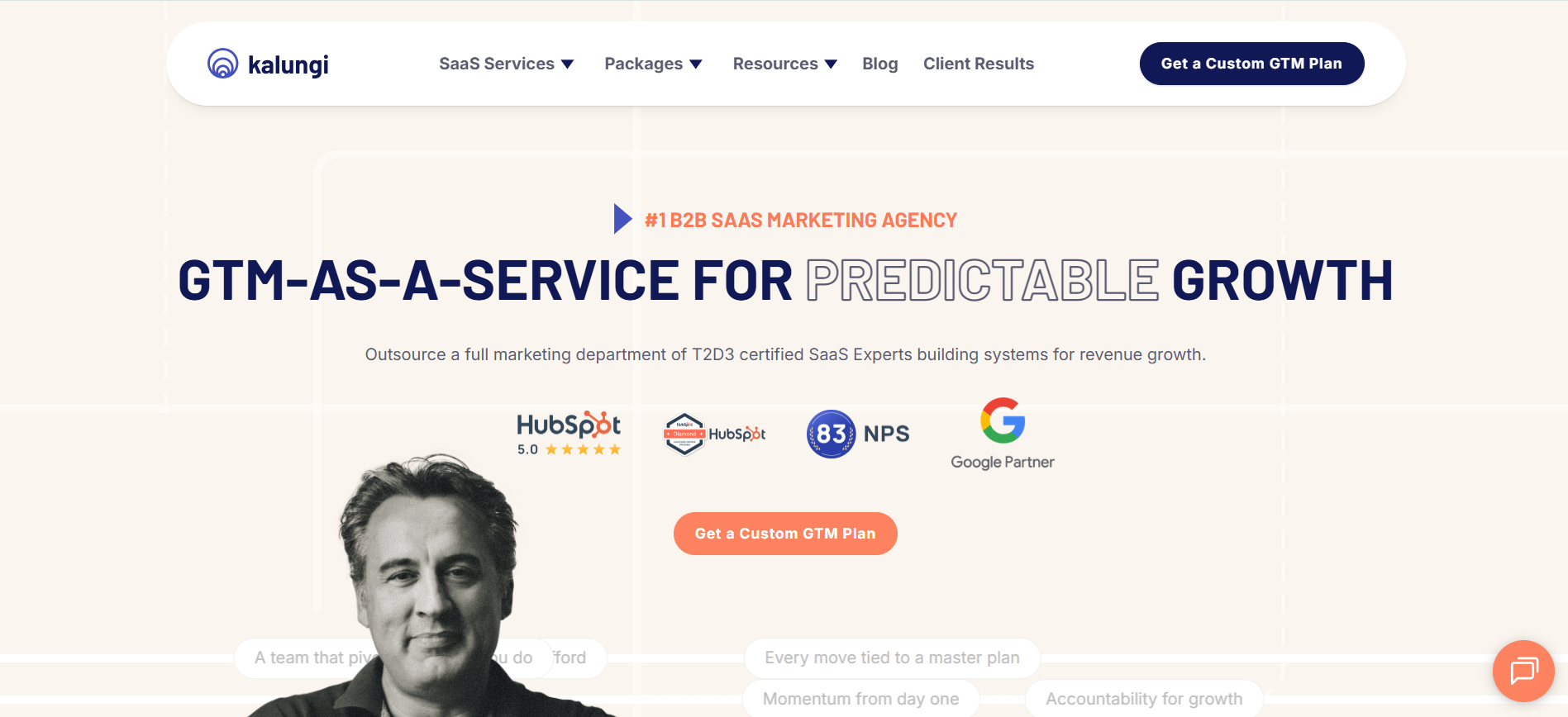
Kalungi is a full-service B2B SaaS marketing agency that operates as an embedded marketing team led by experienced SaaS CMOs. They are built for companies that need both strategic leadership and execution capacity from day one, without hiring a full in-house team. The agency has scaled 150+ B2B SaaS companies using their T2D3 growth playbook (triple, triple, double, double, double). In March 2026, Kalungi announced a leadership transition to support their next growth stage.
Key Services
- Fractional CMO and associate CMO leadership
- Full-funnel SEO and content marketing
- Paid demand generation and ABM
- Marketing operations and HubSpot implementation
- GTM strategy, ICP research, and positioning
Pros
- Complete marketing team with CMO leadership embedded from week one
- T2D3 playbook with verified application across 150+ SaaS companies
- Integrated cross-channel execution reduces vendor coordination overhead
Cons
- Kalungi has publicly stated full-service engagements can be around $45,000/month, depending on scope
- Comprehensive scope means longer onboarding for teams that need fast execution
- Structured for companies rebuilding their entire marketing function, not filling specific gaps
Best For:
Seed to Series B SaaS companies that need strategic marketing leadership plus full execution capacity, and do not yet have a senior marketing hire in-house.
4. TripleDart: Multi-Channel GTM Execution for Growth-Stage SaaS
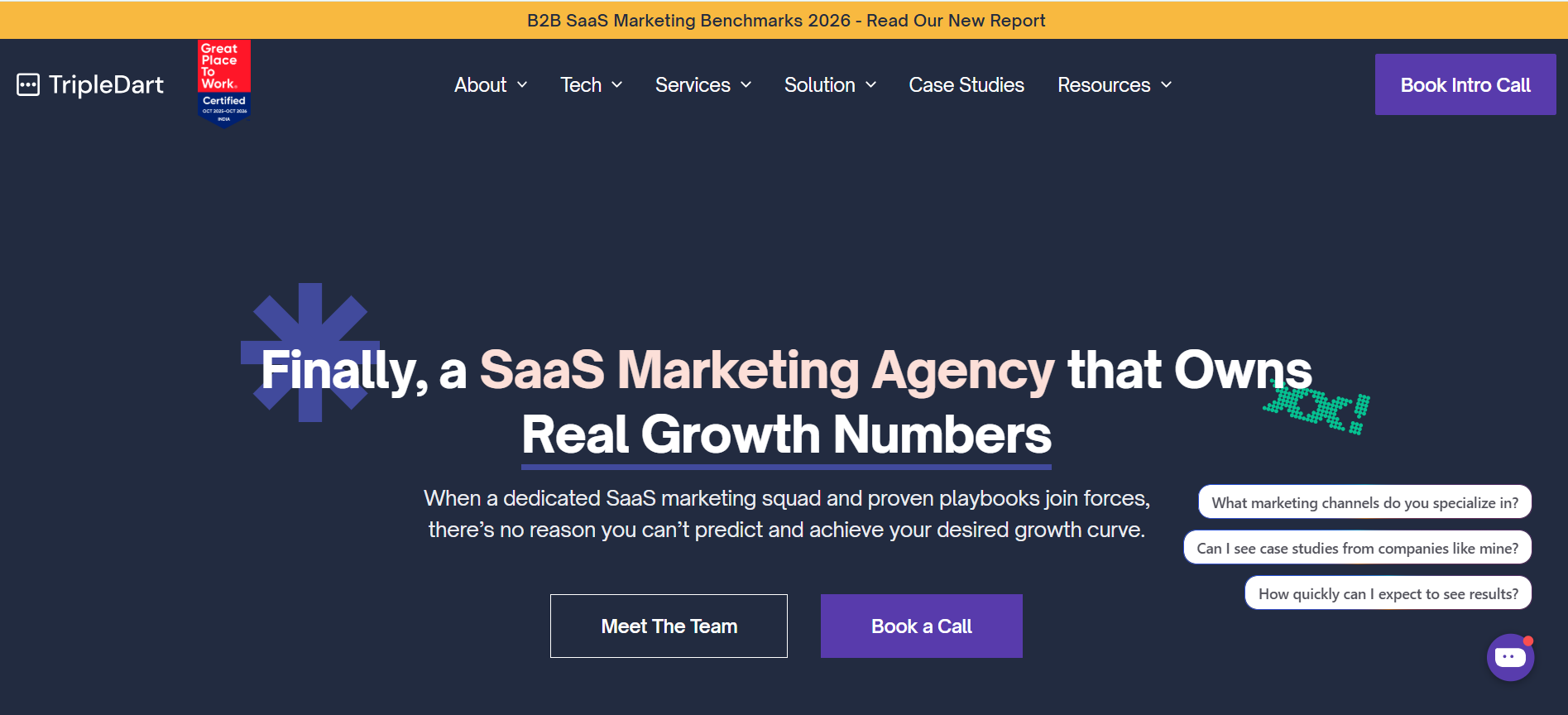
TripleDart is a SaaS-focused growth agency that covers SEO, paid acquisition, content, and marketing operations under one engagement. They have worked with 250+ B2B SaaS companies across 12 countries and are built for teams that need a cross-functional growth partner, not a single-channel vendor. Their core strength is building operational infrastructure that makes internal teams more effective long after the engagement ends.
Key Services
- SEO and product-led content
- Paid acquisition and ABM
- Marketing operations and automation
- Attribution dashboards and KPI reporting
- 30-60-90 day OKR execution model
Pros
- Cross-functional team covers strategy through execution across all channels
- OKR model creates clear milestones and visible delivery accountability
- Marketing ops infrastructure compounds in value after the engagement closes
- Strong fit for teams that need multi-channel orchestration alongside SEO
Cons
- Multi-channel complexity requires internal stakeholders who can manage cross-functional coordination
- Attribution dashboards need existing data infrastructure to function correctly
- Less specialized than a pure SaaS SEO agency for single-channel engagements
Best For:
Series A and beyond SaaS companies that need operational maturity and integrated channel execution, not just an SEO program running in isolation.
.png)
5. First Page Sage: Long-Term Organic Authority for Enterprise SaaS
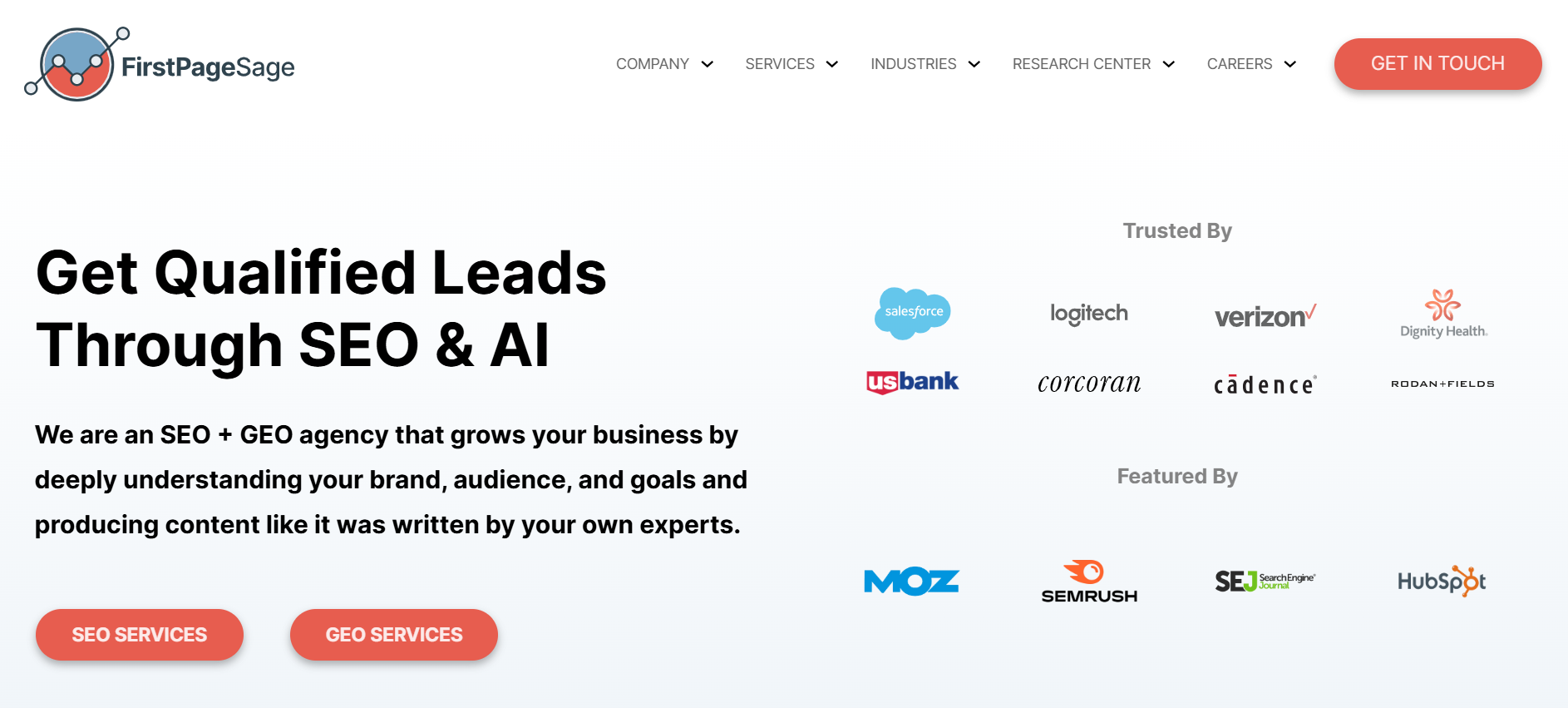
First Page Sage is a content-led SEO agency that builds topical authority and top organic rankings through original research and thought leadership. Their model is built for the long game. They create content that compounds over years, earns citations from AI platforms, and becomes progressively harder for competitors to replicate.
Key Services
- Research-led thought leadership content at scale
- Bottom- and middle-of-funnel keyword targeting
- Technical SEO for enterprise platforms
- Conversion rate optimization embedded into content strategy
Pros
- Builds lasting topical authority that compounds over the years
- Research-driven content earns AI citations and natural backlinks
- Conversion optimization connects high-ranking pages to revenue outcomes
- Strong fit for companies with high contract values and long sales cycles
Cons
- Authority building takes six to twelve months minimum before meaningful pipeline impact
- High content production investment without short-term commercial return
- Not suited to companies with immediate pipeline pressure
Best For:
Established SaaS companies with patient capital that want to own their category through content leadership rather than chase quick rankings.
6. Virayo: Whole-Ecosystem Search Presence Across SEO, Reviews, and AI
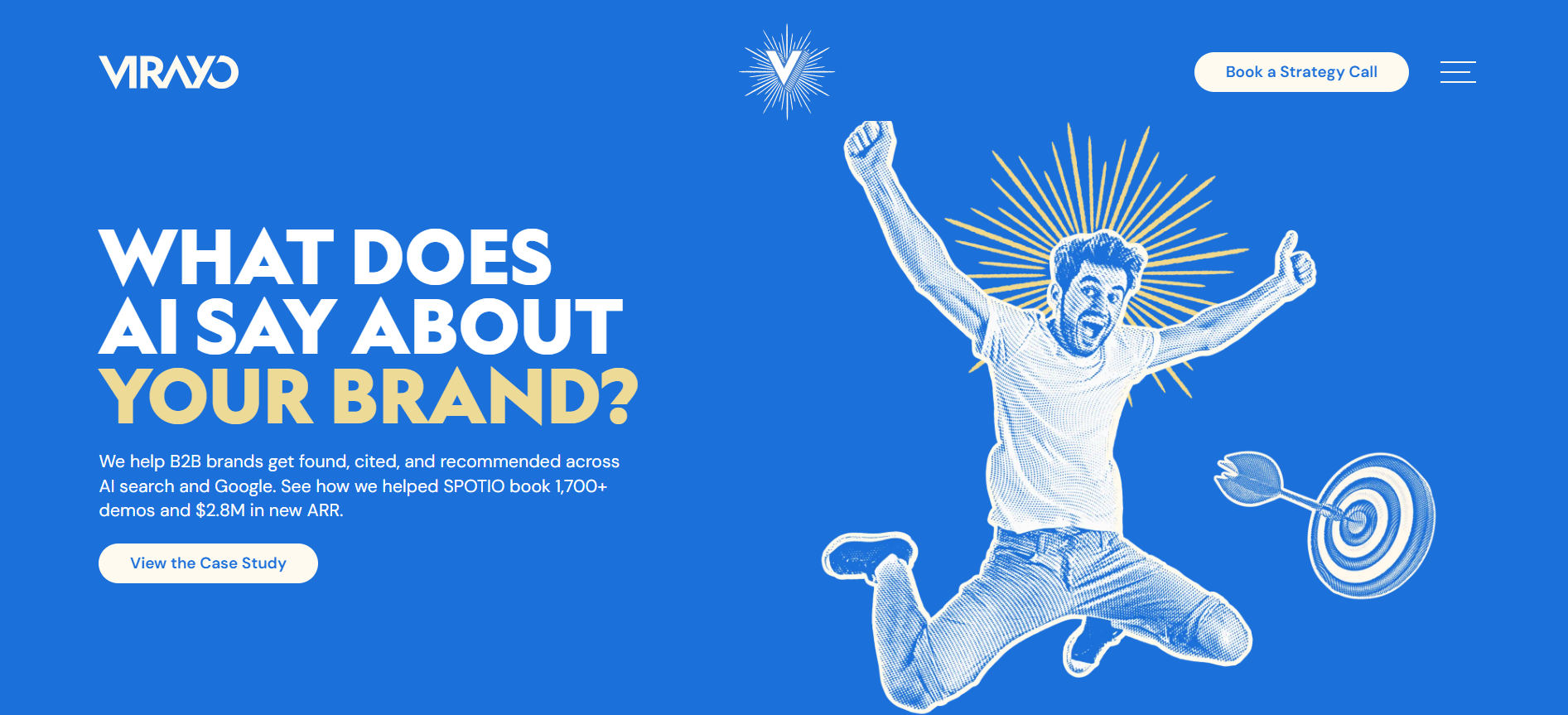
Virayo is a SaaS-focused search agency that goes beyond website SEO to manage your entire search footprint. They recognize that B2B buyers research across Google, G2, Capterra, YouTube, and AI tools like Perplexity and ChatGPT. Optimizing only your website while competitors dominate review platforms and AI-generated answers leaves meaningful pipeline on the table.
Key Services
- Organic SEO and paid search
- G2 and Capterra profile and review optimization
- YouTube SEO and video search presence
- Generative Engine Optimization (GEO) for AI search visibility
- Multi-touch attribution across all search touchpoints
Pros
- Manages the full search ecosystem where SaaS buyers actually research, not just Google
- GEO work positions clients in AI-generated search responses as the channel grows
- Multi-touch attribution gives a complete picture of what is driving pipeline
Cons
- Budget spreads across platforms, which can dilute depth in any single channel
- Managing multiple channels simultaneously creates coordination and reporting overhead
- Less suited to teams that need to master one channel before expanding
Best For:
Mid-market to enterprise SaaS companies with budget for comprehensive search presence and internal capacity to manage multi-channel reporting.
7. MADX Digital: Technical SaaS SEO for Complex Product Architectures
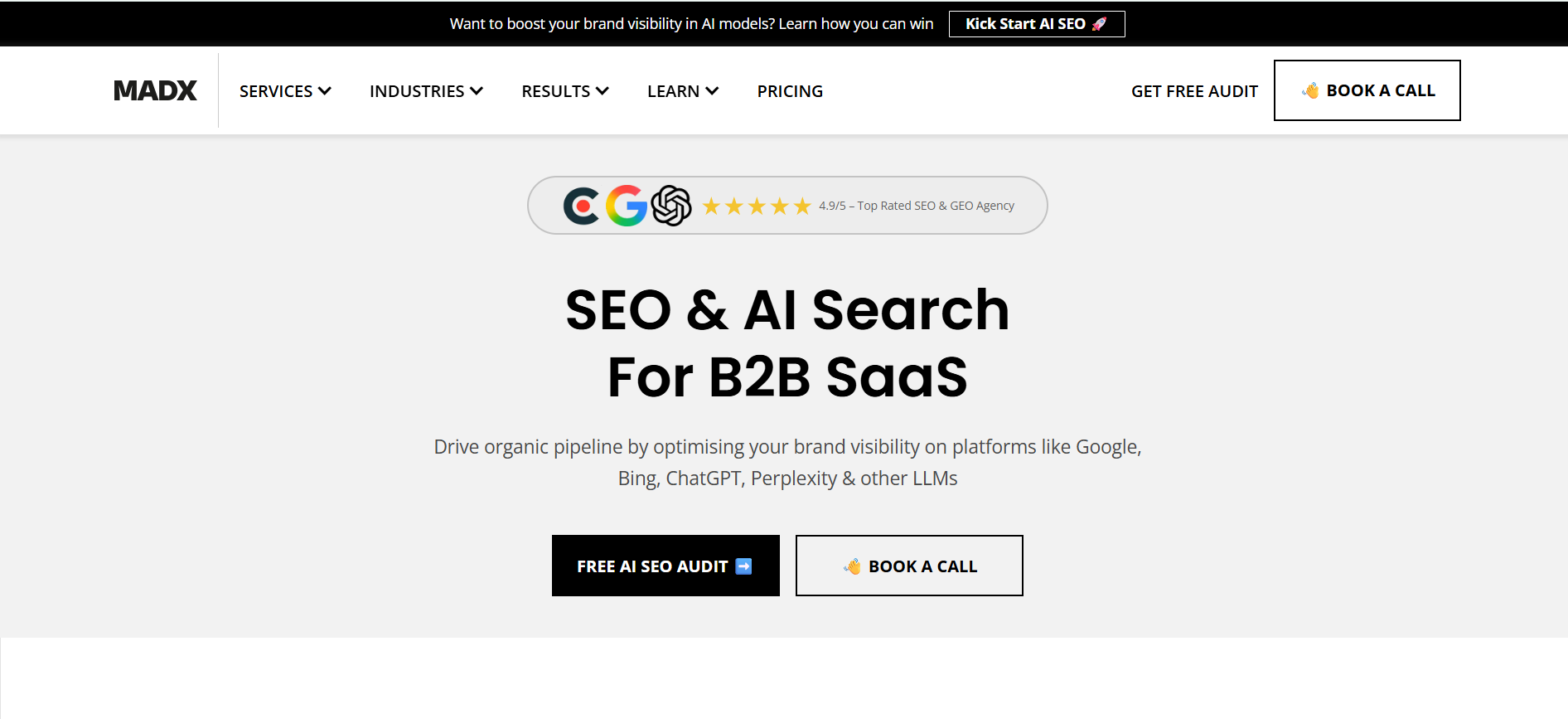
MADX Digital is a London-based SaaS SEO agency that specializes in technical SEO for software companies. They solve the infrastructure problems that prevent strong content from ranking, particularly for product-led companies with heavy JavaScript, complex site structures, or multi-language international setups. They implement fixes directly alongside your dev team, not as recommendation documents that sit in backlogs.
Key Services
- JavaScript rendering and crawl budget optimization
- Structured data and schema markup implementation
- International SEO and hreflang for multi-language SaaS products
- Ongoing algorithm monitoring and technical drift management
Pros
- Deep technical SEO for SaaS architectures that standard agencies cannot handle
- Core Web Vitals expertise delivers ranking improvements before new content is even needed
- Execution-focused: implements alongside your dev team, not just advises
- Rankings guarantee: top-5 positions for three keywords within 90 days or a fee refund
Cons
- Technical wins plateau without a strong content strategy running alongside
- Limited capability for demand generation or paid channel work
- Content partners are needed for full-funnel pipeline impact
Best For:
Technical SaaS products with complex architectures that have content handled internally but need a technical SEO specialist to maximize how that content gets indexed, ranked, and displayed.
Is This List Right for You?
This blog and the agencies on it are built for SaaS teams that track pipeline, care about demo volume, and want SEO to be a revenue function, not a reporting exercise.
This is not right for you if:
- You measure SEO success by traffic volume or keyword rankings alone
- You do not track where demos, trials, or qualified leads come from
- You are not yet ready to build BOFU content: comparisons, alternatives, pricing, and integration pages
- You need a vendor to execute tasks, not an operator to own outcomes
If any of those apply, most agencies on this list will feel like the wrong fit. That is not a criticism. It is a targeting problem, and the fix is internal before it is external.
If you are ready to tie SEO to pipeline, start with a Growth Audit.
.png)
How We Evaluated These B2B SaaS SEO Agencies: The 5-Factor Framework
We did not compile this list based on review site scores or agency brand recognition. We evaluated each agency against the criteria that predict real pipeline output.
ICP-Driven Targeting: Does the agency start with your ideal customer profile before touching keyword tools? Agencies that jump to keyword research first are optimizing for search engines, not buyers.
Product-Led Content Expertise: Can they build content around features, integrations, use cases, and comparisons? Generic blog writing does not move enterprise buyers. We looked for agencies that understand technical product positioning and buying committee dynamics.
Revenue Attribution: Do they track demos, trials, PQLs, and pipeline influence? Or do they stop at traffic and rankings? Every agency on this list ties SEO performance to business outcomes. That is the baseline, not a differentiator.
SaaS-Specific Experience: We looked for proven records with B2B SaaS clients. Working in SaaS means understanding recurring revenue models, expansion opportunities, multi-stakeholder buying committees, and the content types that move each stage.
Operational Transparency: Can they explain what was shipped last week, what is in progress, what is blocked, and what comes next? Week-to-week clarity inside real client constraints matters more than polished case studies.
Why SaaS SEO Requires a Completely Different Playbook Than Standard B2B SEO
Standard B2B SEO runs top-of-funnel first and eventually works down. SaaS SEO starts at the evaluation stage, proves pipeline impact, and expands upward. That is not a subtle difference. It is a fundamentally different brief.
Here is what makes SaaS buying behavior unlike anything a generalist SEO agency is built for:
Long sales cycles with multiple researchers.
Your buyers are not one person. They are a committee, each independently searching the same problem from a different angle. Your content strategy needs to serve a VP of Engineering, a CFO, and a procurement lead simultaneously.
High acquisition costs that demand precision.
Ranking for broad informational keywords wastes CAC budget, attracting audiences who will never buy. ICP-mapped keyword targeting, by company size, job title, and intent stage, is how SaaS SEO pays off.
Expansion revenue depends on the right customer fit.
The wrong customer who found you through vague content churns faster and costs more to serve. The right product marketing and content combination attracts the right buyers and protects NRR.
Evaluation-stage content does the selling before sales get involved.
Comparison pages, alternative content, pricing pages, and integration documentation all target the moment a buyer is actively selecting software. Most agencies build awareness content. The ones on this list build conversion content.
SEO that does not convert is just content production with better reporting.
Across our portfolio at GTMVerse, the highest-converting SaaS pages target three buying jobs simultaneously: confirming the right solution category, eliminating a named competitor, and justifying price to a finance stakeholder. Most awareness-stage blog posts do none of those three things.
How to Choose a B2B SaaS SEO Agency: The GTMVerse 5-Point Partner Test
Hiring the wrong SEO agency rarely fails fast. It fails quietly. Reports look polished, activity feels busy, and months pass without real movement in demos or qualified pipeline. The GTMVerse 5-Point SaaS SEO Partner Test helps you evaluate agencies on delivery, ownership, and operating discipline before you sign anything.
Step 1: Define Your Goal and Constraint in One Sentence
Example: "We need more demo requests from organic search, but our comparison pages do not rank, and we have no internal SEO resources."
Strong agencies respond by prioritizing evaluation pages: comparisons, alternatives, integrations, and use cases. Agencies that default to broad keyword plans and awareness content have already shown you their real priorities.
Step 2: Ask What Ships in the First 30 Days
You should get clear answers on which high-intent pages will be built or optimized, what technical fixes will be implemented, what inputs they need from your team, and what early checkpoints they track.
If the answer is dominated by audits, workshops, and decks with no deliverables, expect slow momentum. Strong SaaS SEO shows directional progress within 60 to 90 days.
Step 3: Clarify Who Owns Outcomes and Who Does the Work
Ask: Who is accountable for the organic pipeline, not just traffic? Who writes the content, and do they understand SaaS buyer intent? Who implements technical changes, and how do they work with your developers?
If SEO recommendations are sitting in an engineering backlog six months after the audit, the agency model is the problem.
Step 4: Understand the Week-to-Week Operating Cadence
A reliable partner can tell you what was shipped last week, what is in progress, what is blocked and why, and what comes next. Operational transparency inside real client constraints is more predictive of long-term performance than any case study.
Step 5: Demand Reporting That Connects SEO to Pipeline
A sample report should show two things. First, execution evidence: what changed on the site, which pages published, and what technical fixes were shipped. Second, performance movement: ranking changes on high-intent evaluation terms, qualified traffic trends to demo and pricing pages, and demo requests attributed to organic search.
Rankings are visibility. Pipeline is the outcome. If reporting stops at the first one, you are paying for a channel that cannot prove its own value.
.png)
Why Most B2B SaaS SEO Fails
Before you shortlist, most SaaS SEO programs fail for the same four reasons. Not algorithm changes. Not budget. Execution and prioritization.
- No ICP mapping: Content is written for everyone, which means it converts no one. Keywords are chosen by volume, not by buyer profile.
- No BOFU pages: Comparison pages, alternatives, integrations, and pricing content are missing entirely. The content that actually drives demos is an afterthought.
- No attribution: Traffic reports replace revenue reporting. Nobody can answer which pages influenced which deals.
- No ownership: An account manager coordinates. A junior writer executes. Nobody is accountable for pipeline. The agency delivers. You own the outcome alone.
If any of these sound familiar, the problem is not your product or your market. The problem is the model.
Key Takeaways
- Start with the buyer, not the keyword. ICP mapping comes before keyword research. Always.
- BOFU converts. Awareness drives traffic. Know which gap you are filling before signing anything.
- A majority of the B2B buying journey is self-directed (Gartner, 2024). Organic search is where decisions get made, not where they get influenced afterwards.
- Pipeline attribution is the baseline. If your agency cannot connect specific pages to demo requests, it cannot prove value.
- Pay for the gaps you have. Modular engagements outperform full retainers when you have partial internal resources.
- Use the GTMVerse 5-Point Partner Test: constraint in one sentence, first-month deliverables, ownership clarity, operating cadence, pipeline-connected reporting.
GTMVerse's POV
SEO does not fail because of keywords. It fails because nobody owns revenue.
Most SaaS teams hire an SEO agency, a content agency, and a paid agency, then spend 40% of their time coordinating between them instead of driving pipeline. We built GTMVerse to end that fragmentation. SEO that does not convert is just content production. Rankings without demos are visibility without outcome.
Every agency on this list is strong at what it does. The question is whether you want a vendor delivering outputs or an operator owning results.
If you want SEO to drive pipeline, not just traffic, start here.
.png)
Frequently Asked Questions About B2B SaaS SEO Agencies
How long does B2B SaaS SEO take to show results?
Directional signals, including ranking movement on high-intent keywords and qualified traffic to evaluation pages, typically appear within 60 to 90 days. Meaningful pipeline impact follows as deals progress through sales cycles. The best agencies prioritize BOFU wins early to prove value before expanding coverage upward.
Is SaaS SEO different from regular B2B SEO?
Yes. SaaS SEO is tightly coupled to product evaluation, comparison behavior, and conversion paths like demos or free trials. It requires alignment with ICP, product capabilities, and revenue attribution. Traditional B2B SEO focuses on awareness-stage content. SaaS SEO starts at the evaluation stage and works upward from there.
Should SaaS SEO start with blog posts or evaluation pages?
Evaluation pages come first. Comparison pages, alternatives, integrations, pricing content, and use cases capture buyers who are actively selecting software. Blog content earns its place once BOFU pages are performing. Agencies that lead with blog content are optimizing for traffic, not pipeline.
What metrics matter most for B2B SaaS SEO?
Demo requests, trial signups, product-qualified leads, assisted conversions, and pipeline influenced by organic search. Traffic volume and keyword rankings are supporting signals, not primary success measures. If your agency reports monthly without connecting rankings to revenue, you are measuring the wrong things.
Can early-stage SaaS companies invest in SEO?
Yes, but scope matters. Early-stage teams should target a narrow set of high-intent evaluation pages rather than broad content programs. Modular engagements deliver better ROI than full-scale retainers at seed or pre-Series A stage. Prove BOFU performance first, then expand.
How do I know if a B2B SaaS SEO agency understands my product?
They will ask detailed questions about your sales cycle, deal size, ICP, buyer roles, and product differentiation before discussing keywords. They will prioritize bottom-funnel content early and explain how specific pages connect to revenue outcomes. If the first conversation is about traffic projections, keep looking.
FAQs
GTMVerse works best with companies where scale introduces fragmentation, not simplicity.


Growth shouldn’t feel uncertain
When Go-To-Market has an owner, clarity replaces chaos, and momentum compounds. Let us own your Go-To-Market, end to end.