

Most businesses are optimizing the wrong metrics
Most businesses running PPC are optimizing the wrong metrics - and quietly burning budget every day.
You see good CTR.
You see low CPC.
You even see leads coming in.
But here’s the problem:
None of that guarantees customers.
And if you are not tracking that properly, you don’t have a growth engine - you have a spend engine.
While most teams celebrate cheaper leads, the top 1% of operators are focused on one thing:
How much it actually costs to acquire a paying customer.
That gap is where most of the market loses money - and where serious growth teams win.
At GTMVerse, we’ve worked across B2B SaaS, local businesses, and high-intent funnels - and in every case, one metric determines whether a campaign scales or fails:
Customer Acquisition Cost (CAC).
Quick Answer
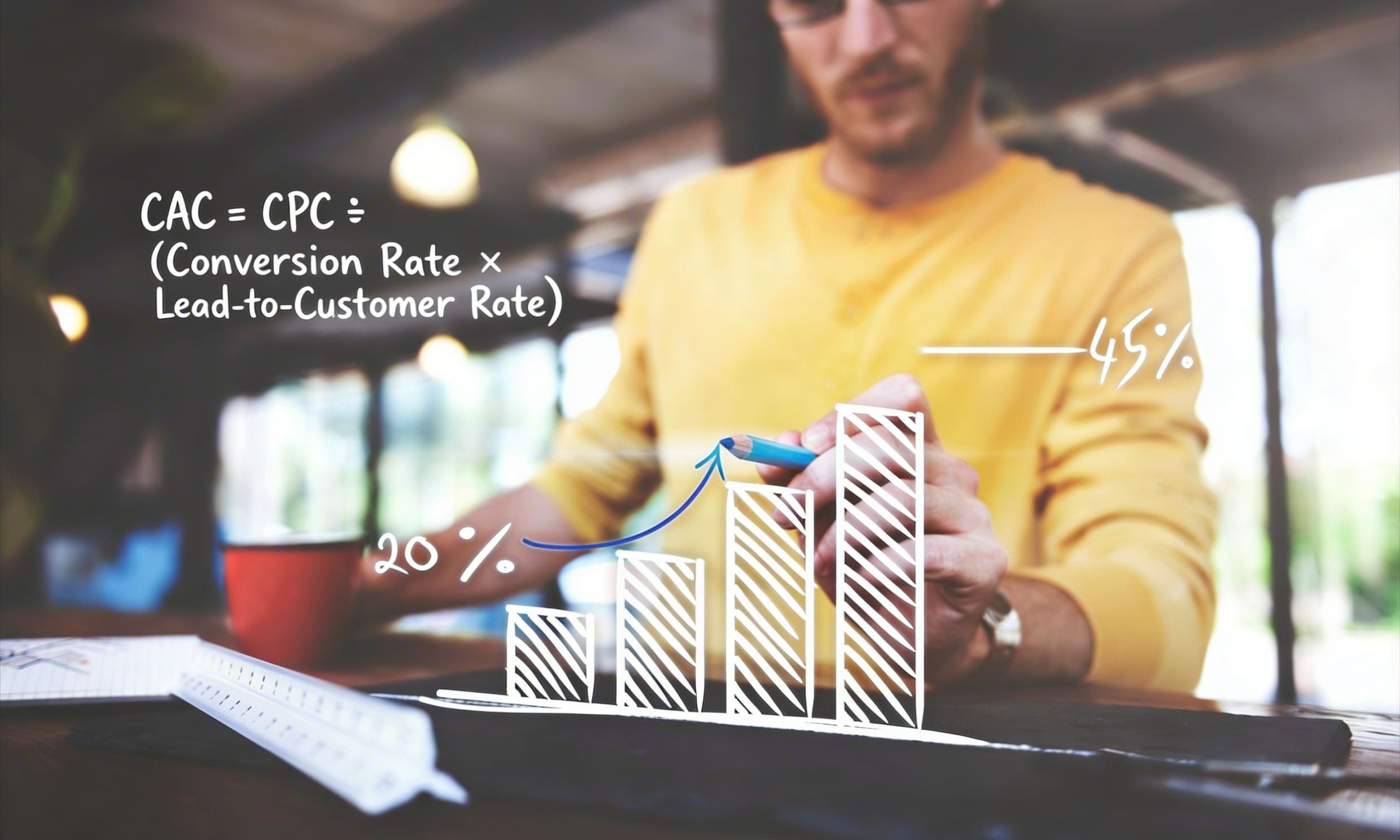
Formula: CAC = CPC ÷ (CVR × Lead-to-Customer Rate)
This single formula tells you whether your ads are making money - or just generating activity.
Example
- CPC = $2.50
- CVR = 5% = 0.05
- Lead → Customer = 20% = 0.20
Step: 0.05 × 0.20 = 0.01 | 2.50 ÷ 0.01 = $250 CAC
This means you are paying $250 to acquire one customer.
If your average customer value is below this, your campaign is losing money - even if leads look cheap.
Because once you understand this, everything changes:
- You stop scaling what looks good
- You start scaling what actually makes money
- You know exactly what to fix in your funnel
Why CAC Is the Only Metric That Matters
Most PPC accounts are optimized around CTR, CPC, or CPL.
Those metrics matter - but none of them tells you whether your campaign is producing profitable customers.
You can have:
- High CTR
- Low CPC
- Cheap leads
…and still lose money.
Most campaigns don’t fail because of bad ads. They fail because of weak conversion systems.
The Real PPC Growth Equation
Revenue = Traffic × Conversion Rate × AOV
CAC = CPC ÷ (CVR × Lead-to-Customer Rate)
This is why senior marketers do not look at metrics in isolation.
- CPC affects cost
- CVR affects efficiency
- Lead-to-customer rate affects revenue
Together, they determine profitability
Real-World Examples
SaaS
Example: CPC = $2.50, landing page CVR = 5%, lead-to-customer rate = 20%👉 CAC = 2.50 ÷ (0.05 × 0.20) = $250
B2B Lead Gen
Example: CPC = $3.00, CVR = 10%, lead-to-customer rate = 25%👉 CAC = 3.00 ÷ (0.10 × 0.25) = $120
eCommerce
Example: CPC = $1.20, purchase CVR = 3%👉 CAC = 1.20 ÷ 0.03 = $40
Local Business
Example: CPC = $0.80, lead CVR = 20%, booking rate = 50%👉 CAC = 0.80 ÷ (0.20 × 0.50) = $8
How PPC Metrics Actually Connect
Targeting and creative quality influence CTR.
CTR influences CPC through Quality Score and relevance.
CPC and landing page quality influence CVR.
CVR influences CPL.
CPL and sales conversion determine CAC.
CAC determines whether to scale, fix, or stop the campaign.
What Actually Moves CAC
Conversion Rate: The fastest lever. Improving conversion rate can cut CAC dramatically.
Lead-to-Customer Rate: Often ignored, but this is where high-quality funnels win.
CTR: An indirect lever that can reduce CPC and improve traffic quality.
Final Takeaway
CAC is the truth metric in PPC. CTR, CPC, and CVR are not meaningless, but they are only levers. CAC tells you whether your paid system actually works.
FAQ
What is the PPC formula for CAC?
CAC = CPC ÷ (Conversion Rate × Lead-to-Customer Rate)
This formula shows the true cost of acquiring a paying customer from paid ads by combining traffic cost, funnel efficiency, and sales performance.
What is CAC in PPC?
CAC in PPC is the total cost required to acquire one paying customer through paid advertising.
What is the formula for CAC in PPC?
CAC = CPC ÷ (Conversion Rate × Lead-to-Customer Rate)
What is a good CAC?
A good CAC depends on your business model and LTV, but it should typically stay below 30–40% of LTV.
How can I reduce CAC in Google Ads?
You can reduce CAC by improving conversion rate, targeting high-intent traffic, optimizing landing pages, and improving lead quality.
How does CPC impact CAC in PPC?
CPC directly impacts CAC because it is the cost input in the formula. Higher CPC increases CAC unless conversion rate or lead-to-customer rate improves.
What is the difference between CPL and CAC?
CPL measures cost per lead, while CAC measures cost per customer. Low CPL does not guarantee low CAC if lead quality is poor.
Why is my CAC high even with a good CTR?
CTR reflects ad engagement, not revenue efficiency. If CVR or lead-to-customer rate is low, CAC will still be high.
What is the fastest way to reduce CAC?
Improving conversion rate is usually the fastest lever to reduce CAC without increasing spend.
How does lead quality affect CAC?
Higher-quality leads convert better, reducing CAC. Poor targeting increases CAC due to low sales conversion.
What CAC should I target for scaling?
Scale when CAC is consistently below your target threshold, typically aligned with LTV (≤30–40%).
Can I scale campaigns with a high CAC?
Only if your LTV supports it. Otherwise, scaling will reduce profitability.
How does landing page optimization reduce CAC?
Better landing pages increase conversion rate, which directly reduces CAC.
Does Quality Score affect CAC?
Yes. Higher Quality Score reduces CPC, which lowers CAC.
What role does targeting play in CAC?
Better targeting improves both CVR and lead-to-customer rate, reducing CAC.
How do I calculate CAC for eCommerce vs lead gen?
For eCommerce: CAC = CPC ÷ Purchase Conversion Rate
For Lead Gen: CAC = CPC ÷ (Lead Conversion Rate × Lead-to-Customer Rate)
What is a good conversion rate for lowering CAC?
Even a 20–30% improvement in conversion rate can significantly reduce CAC.
How does retargeting affect CAC?
Retargeting lowers CAC by targeting warm users who are more likely to convert.
Why does CAC increase when scaling budgets?
Scaling expands reach to lower-intent audiences, which reduces efficiency and increases CAC.
How do I diagnose high CAC in my funnel?
Break it into: CPC → CVR → Lead-to-Customer Rate.
Identify the weakest stage and optimize that layer.
FAQs
GTMVerse works best with companies where scale introduces fragmentation, not simplicity.
CAC in PPC is the total cost required to acquire one paying customer through paid advertising.


Growth shouldn’t feel uncertain
When Go-To-Market has an owner, clarity replaces chaos, and momentum compounds. Let us own your Go-To-Market, end to end.